Shopify Email Flows: The 5 Every Store Needs (Timing + Examples)
The 5 ecommerce email flows every Shopify store needs—welcome, abandoned cart, browse abandonment, post-purchase, and winback—with exact send timing, subject-line examples, and SMS add-ons.
Most Shopify stores spend hard to win the click, then let the relationship go cold the moment the visit ends. Shopify email flows are the automated sequences that fix that—they turn one visit into a first order, and one order into many, without you touching a thing after setup. Unlike a one-off campaign, a flow triggers off behavior (a signup, an abandoned cart, a delivered order) and runs 24/7. This guide breaks down the five flows every store needs in plain English, then shows you how to set them up. If you want the deeper retention playbook afterward, see our email + SMS retention guide.
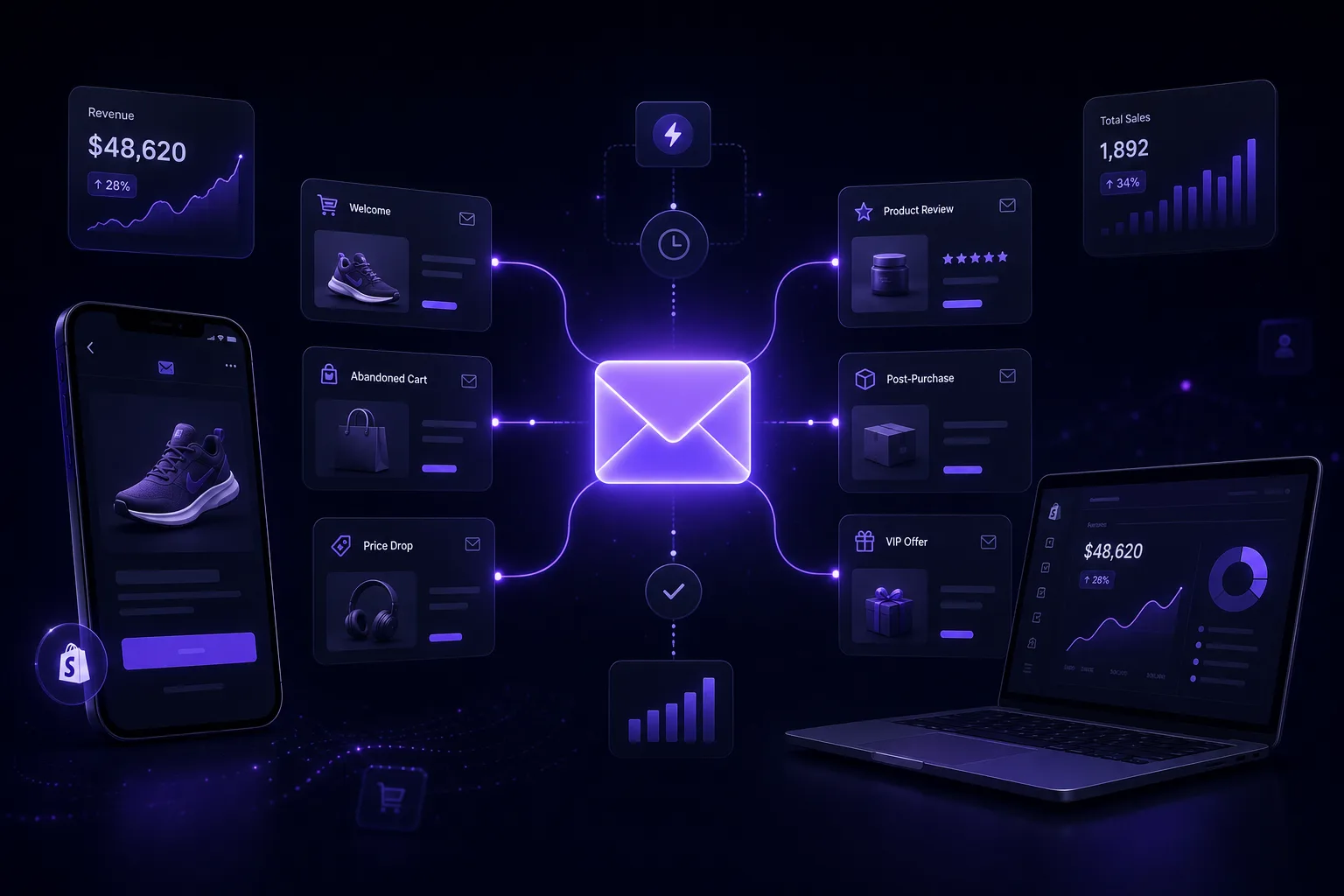
Prefer the printable version? Download the free 5 Email Flows Every Shopify Store Needs guide (PDF)—a one-page cheat sheet you can keep open while you build each flow.
What's inside this guide
- The 5 must-have email flows and exactly what each one is for
- When each flow triggers and how many emails it should contain
- A quick-start checklist to get all five live without overwhelm
- The common email mistakes that quietly cost Shopify stores revenue
- A simple "what good looks like" benchmark for your automation
The 5 email flows, in plain English
Campaigns are one-time broadcasts; flows are automated sequences triggered by what a shopper does. These five cover the whole customer journey—from first signup to lapsed-customer revival—and together they become one of the highest-margin channels a Shopify store has.
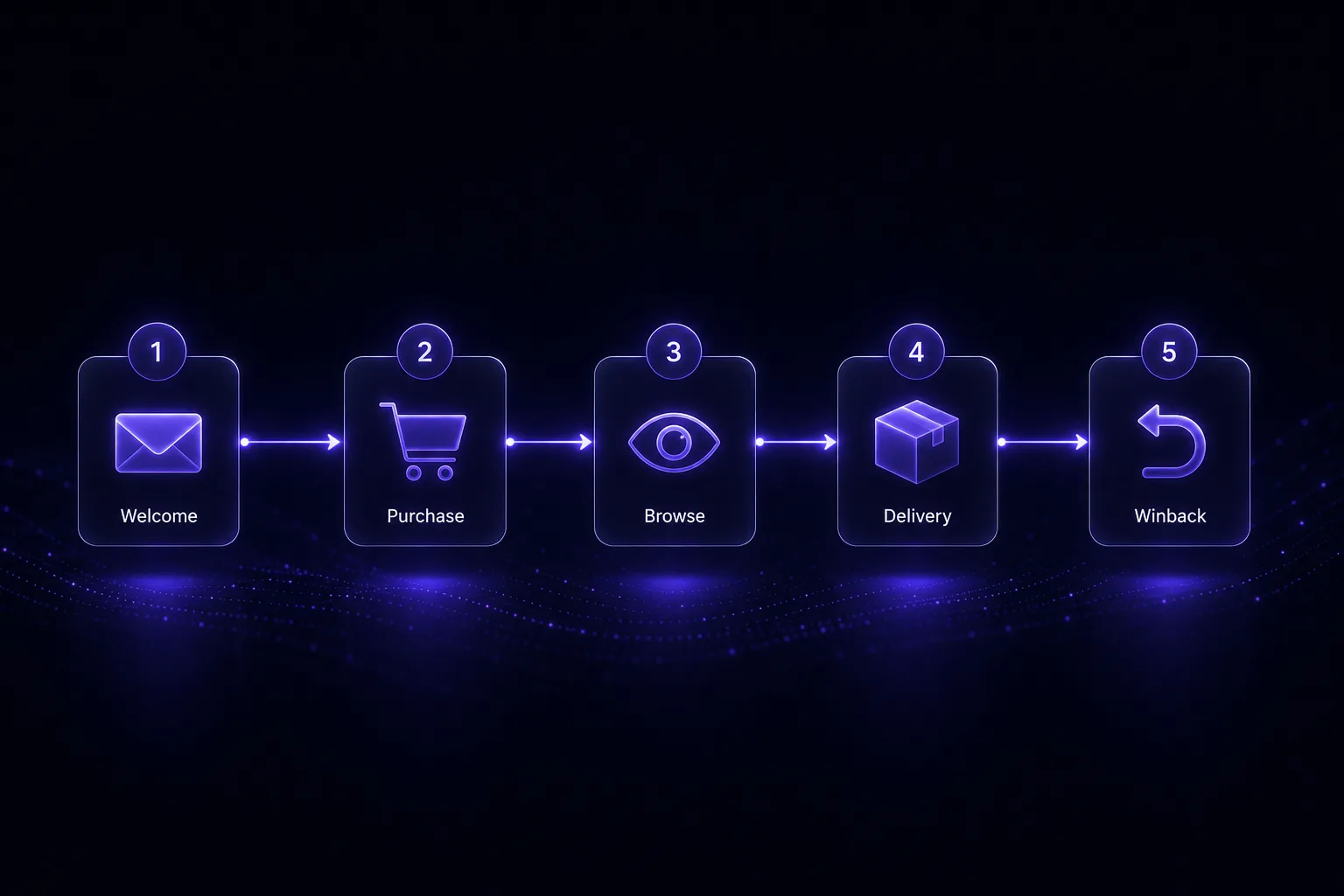
1. Welcome series
Triggers the moment someone subscribes—through a popup, a footer signup, or a checkout opt-in. It's your strongest first impression and your most-opened flow, so it does the heavy lifting of turning a new subscriber into a first-time buyer. A store with no welcome flow lets its warmest subscribers go cold.
The sequence:
| # | Send at | Job of the email | Subject-line example |
|---|---|---|---|
| 1 | Immediately | Deliver the incentive; confirm they're in | "Here's your 10% off — welcome in" |
| 2 | +1 day | Brand story; why you exist | "Why we started making these" |
| 3 | +3 days | Bestsellers + social proof | "The 3 our customers reorder most" |
| 4 | +6 days | Objection handling; expiry nudge | "Your discount expires tomorrow" |
Deliver the incentive in email 1 within seconds—if it's late, the subscriber has already left. If you offer no incentive, replace it with your single best product story.
2. Abandoned cart and checkout
Triggers when a shopper adds to cart or starts checkout but doesn't complete the order—the single most immediate pool of recoverable revenue. Include the product image, star ratings, and a one-click link straight back to the cart. Don't lead with a discount—save it for the last email, if at all.
The sequence:
| # | Send at | Job of the email | Subject-line example |
|---|---|---|---|
| 1 | +1 hour | Friendly nudge; no discount | "You left something behind" |
| 2 | +24 hours | Kill objections: shipping, returns, reviews | "Free returns, in case you were wondering" |
| 3 | +48 hours | Optional incentive / scarcity | "Still yours — but not for long" |
Separate cart abandonment (added to cart) from checkout abandonment (entered checkout). Checkout abandoners are further along and deserve the more urgent sequence. For the full recovery system—including SMS and on-site nudges—see our cart recovery playbook.
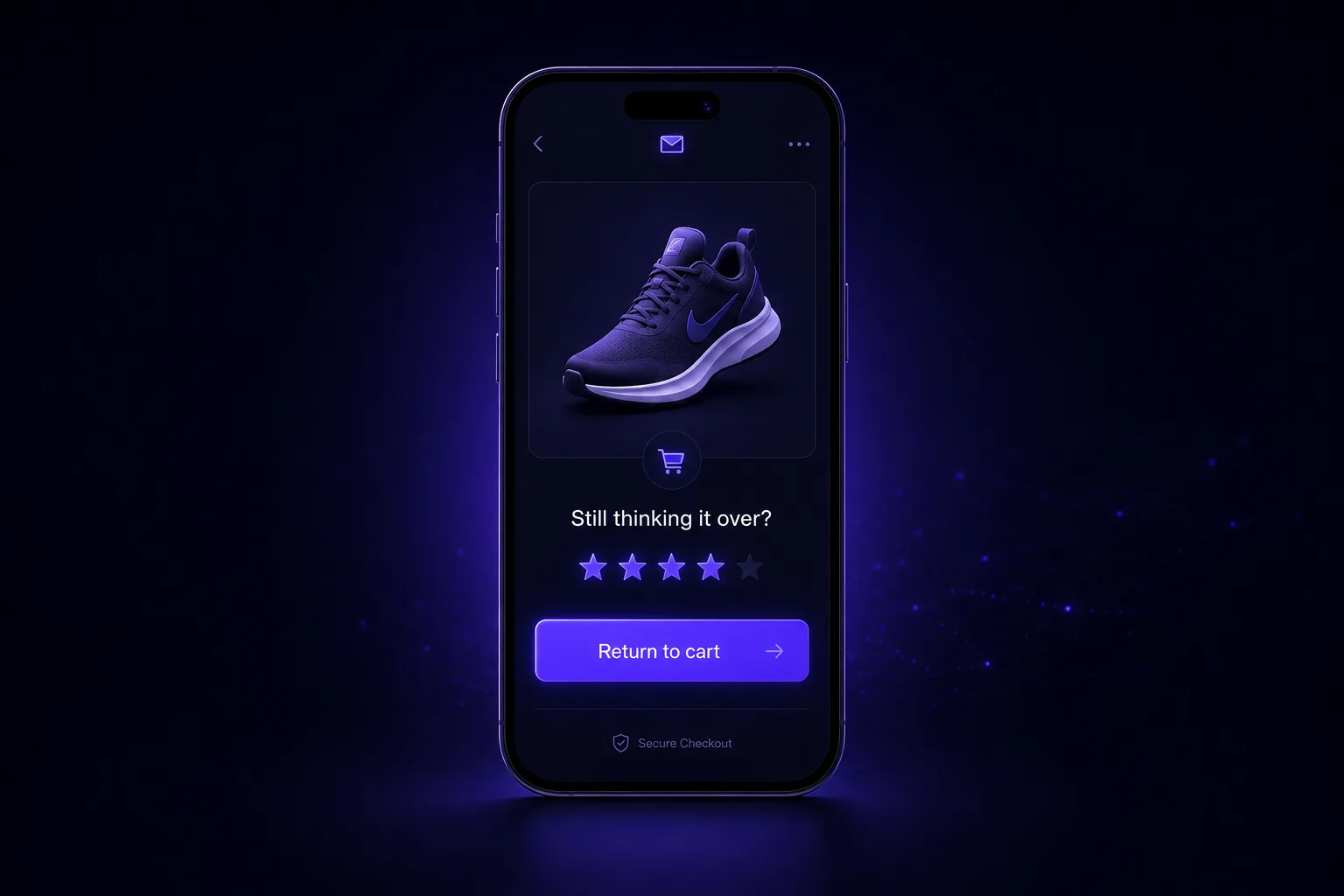
3. Browse abandonment
Triggers when a known contact views a product or collection but never adds it to cart. Intent is lower than an abandoned cart, but this flow quietly catches researchers who were close. One or two emails do the job: "still thinking about this?" featuring the exact product they viewed, a couple of related items, and social proof to nudge them back.
4. Post-purchase
Triggers after an order is placed, and it's where one-time buyers become repeat customers. Done well, post-purchase lifts lifetime value, reduces "where's my order?" support tickets, and earns the reviews that power the rest of your marketing.
The sequence:
| # | Send at | Job of the email | Subject-line example |
|---|---|---|---|
| 1 | Immediately | Order confirmation (transactional) | "Order #1234 confirmed" |
| 2 | +1 day | Thank-you; set delivery expectations | "What happens next with your order" |
| 3 | +3 days post-delivery | Review request | "How did we do?" |
| 4 | +14–30 days | Cross-sell or replenishment | "Running low? Here's your refill" |
Time the replenishment email to your actual product cycle—a 30-day serum gets a day-25 nudge, not a day-14 one. Pair the cross-sell with the pairings from our AOV playbook.
5. Winback and sunset
Triggers when a customer hasn't bought or engaged in a set window—often 60–120 days. Reviving a past customer is far cheaper than acquiring a new one, so this flow protects margin. Send 2–3 emails: a "we miss you" with bestsellers, then an incentive, then a final sunset email (last chance or update-your-preferences). Sunsetting truly dead contacts also protects your deliverability so the rest of your flows keep landing in the inbox.
Transactional emails: the ones you already send
Order confirmations, shipping notifications, delivery updates, and password resets are transactional emails—triggered by an action, expected by the customer, and sent regardless of marketing consent. They quietly earn the highest open rates of anything you send, which makes them the most-wasted real estate in ecommerce.
Two rules. First, keep them separate from marketing flows—mixing promotional blasts into transactional sends creates compliance risk and hurts deliverability. Second, use the attention: a clean order confirmation with your brand voice, a support link, and one tasteful related-product row does far more than Shopify's default template. Don't turn the receipt into an ad; do make it feel like your brand.
Adding SMS to your flows
SMS isn't a separate strategy—it's a faster lane inside the flows you already have. Because open rates are near-instant, it works best where timing decides the outcome:
- Abandoned checkout: one SMS at ~30–60 minutes, before the email lands. This is the highest-value SMS you'll send.
- Shipping updates: the message customers actually want, and it cuts support tickets.
- Back-in-stock and launches: urgency-driven moments where minutes matter.
Keep it to one message per moment, always get explicit opt-in (SMS consent is separate from email consent), and honor quiet hours in the recipient's timezone. Two SMS a week is a rhythm; five is an unsubscribe. Our email + SMS retention guide covers segmentation across both channels.
Quick-start checklist
You don't need all five live on day one. Get the highest-revenue flows (welcome and abandoned cart) running first, then add the rest:
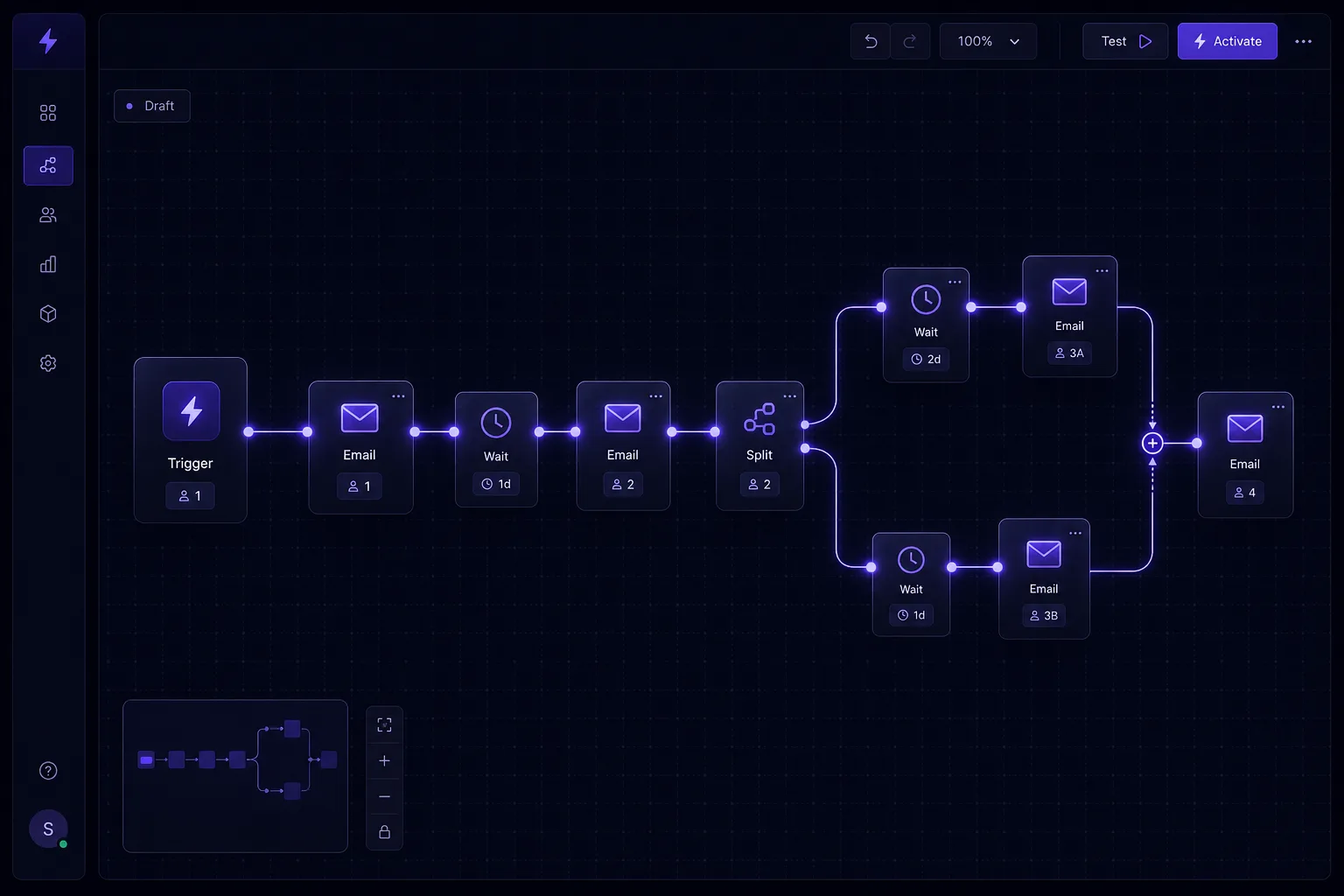
- Capture emails with a popup and a footer form, offering a clear reason to subscribe
- Authenticate your sending domain (SPF, DKIM, DMARC) before sending—deliverability comes first
- Build the flows in your ESP (Klaviyo, Shopify Email, etc.) before spending more on ads
- Segment engaged vs. unengaged contacts and mail mostly the engaged ones
- Personalize with the shopper's name, the product they viewed, and dynamic recommendations
- Use one clear call-to-action per email and a mobile-first template
- Review revenue-per-recipient monthly and test subject lines and send timing
- Keep transactional emails separate from marketing flows
Want it on one page? Download the free 5 Email Flows cheat sheet (PDF) and check each flow off as you build it. Need the actual wording for each email? Our ecommerce email swipe file has copy-and-paste templates for all five flows.
Common mistakes that quietly cost you
- Discounting in every email, which trains customers to wait for the next sale
- Running only an abandoned-cart flow and ignoring the other four
- Blasting the entire list regardless of engagement, which tanks deliverability
- No welcome flow, so your warmest new subscribers cool off
- Batch-and-blast campaigns instead of triggered, personalized flows
- Skipping post-purchase, leaving easy repeat revenue on the table
- Never sunsetting unengaged contacts, dragging your inbox placement down
What good looks like
A store with all five flows live earns a meaningful, dependable share of its revenue on autopilot. Welcome converts new subscribers, abandoned cart and browse recover sales that would otherwise vanish, post-purchase turns buyers into reviewers and repeat customers, and winback revives the ones who drifted—none of it leaning on constant discounts or torching deliverability. The flows run around the clock, stay personalized, and get a quick monthly review for revenue-per-recipient. That's the bar: automated, on-brand, and compounding.
How Virexo Media helps with Shopify email flows
Mapping the flows is the easy part; building them cleanly in your ESP, writing on-brand emails, and tying them to your store data is where most teams stall. Our team sets up and optimizes lifecycle email for Shopify brands as part of our Shopify development and content creation work, and we pair it with performance marketing so the traffic you pay for keeps paying you back. When you're ready to go beyond the basics, the email + SMS retention guide covers segmentation and LTV in depth.
The numbers behind the work: 80+ clients served, 50+ Shopify stores built, $2.4M+ in revenue scaled, and a 5.2x average ROAS across our ecommerce campaigns.
"The Shopify store they built for us is stunning and converts like crazy. Combined with their performance marketing, our revenue tripled in the first quarter."
— Ayesha Khan, E-Commerce Manager, LuxeWear (UAE)
Frequently asked questions
What are the 5 essential Shopify email flows?
The five every store needs are: a welcome series, an abandoned cart/checkout flow, a browse abandonment flow, a post-purchase flow, and a winback (with a sunset) flow. Together they cover the full journey from new subscriber to lapsed customer.
Which email flow should I set up first?
Start with the welcome series and the abandoned cart flow—they reach your most engaged and highest-intent shoppers, so they recover revenue the fastest. Add browse abandonment, post-purchase, and winback once those two are live.
What's the difference between an email flow and a campaign?
A flow is automated and triggered by behavior (a signup, an abandoned cart, a delivered order), so it runs continuously without manual work. A campaign is a one-time broadcast you send to a segment, like a product launch or a sale announcement. Most stores need both, but flows do the compounding work.
How many emails should each flow have?
As a starting point: welcome 3–4, abandoned cart 2–3, browse abandonment 1–2, post-purchase 3–4 (including transactional touches), and winback 2–3. Start lean, then add emails where the data shows engagement.
Do I need Klaviyo, or is Shopify Email enough?
Shopify Email is fine to launch your first flows on a small list. As your list grows and you want advanced segmentation, branching flows, and deeper store data, a dedicated platform like Klaviyo earns its cost—see our Klaviyo for Shopify guide.
What email flows should I have before running paid ads?
At minimum, the welcome series and the abandoned cart/checkout flow. Paid traffic is expensive and most of it won't buy on the first visit—without those two flows you're paying to acquire visitors and then letting them disappear. Add browse abandonment and post-purchase soon after so the traffic you buy keeps paying you back.
Are ecommerce email flows different from Shopify email flows?
No—the five flows in this guide (welcome, abandoned cart, browse abandonment, post-purchase, winback) are the standard for any ecommerce store, on any platform. Shopify just makes them easier to trigger because the store data (carts, orders, products) connects natively to tools like Klaviyo and Shopify Email. The strategy is identical on WooCommerce or BigCommerce; only the setup differs.
What's the difference between transactional and marketing emails?
Transactional emails (order confirmations, shipping updates, password resets) are triggered by a customer action, expected, and sent regardless of marketing consent. Marketing emails and flows require opt-in. Keep them on separate streams—mixing promotional content into transactional sends creates compliance risk and can hurt your deliverability.
Should I add SMS to my email flows?
Add SMS where timing decides the outcome—abandoned checkout (one message at ~30–60 minutes), shipping updates, and back-in-stock alerts. It's a faster lane inside your existing flows rather than a separate strategy. Get explicit SMS opt-in separately from email consent, respect quiet hours, and keep it to about two messages a week.
How much revenue can email flows drive?
It varies with your store, list size, and margins, but well-built flows often become one of the highest-ROI channels a Shopify store has, because they run automatically and target shoppers at their most likely moment to buy. The honest answer is that the lift comes from having all five live and reviewed—not from any single "magic" email.
Ready to put your email on autopilot?
Virexo Media helps D2C and Shopify brands build the flows—and the campaigns that feed them—that turn one-time buyers into repeat revenue. Book a free strategy call and we'll review your current email setup and send a prioritized action list within 48 hours.
Explore our website development, content creation, and performance marketing pages.
Want a free audit of your store?
Book a 15-minute call with Virexo Media. We'll review your Shopify site, ads, or SEO — and send a prioritized action list within 48 hours. No pitch deck. Just clarity.