Meta Ads Creative Audit: 12-Point ROAS Checklist
A Meta ads creative audit for D2C & Shopify brands: the 5 mistakes draining ROAS, a 12-point creative checklist, and placement specs to fix before your next launch.
If your Facebook and Instagram ROAS is stuck, the budget probably isn't the problem—the creative is. This Meta ads creative audit is the working checklist our team runs on D2C and Shopify ad accounts before a launch: the five mistakes quietly draining ROAS, the fixes, a 12-point creative scorecard you can run today, and the placement specs most stores get wrong. It pairs with the hands-on work we do on performance marketing retainers, so you can apply it whether you run ads in-house or with us.
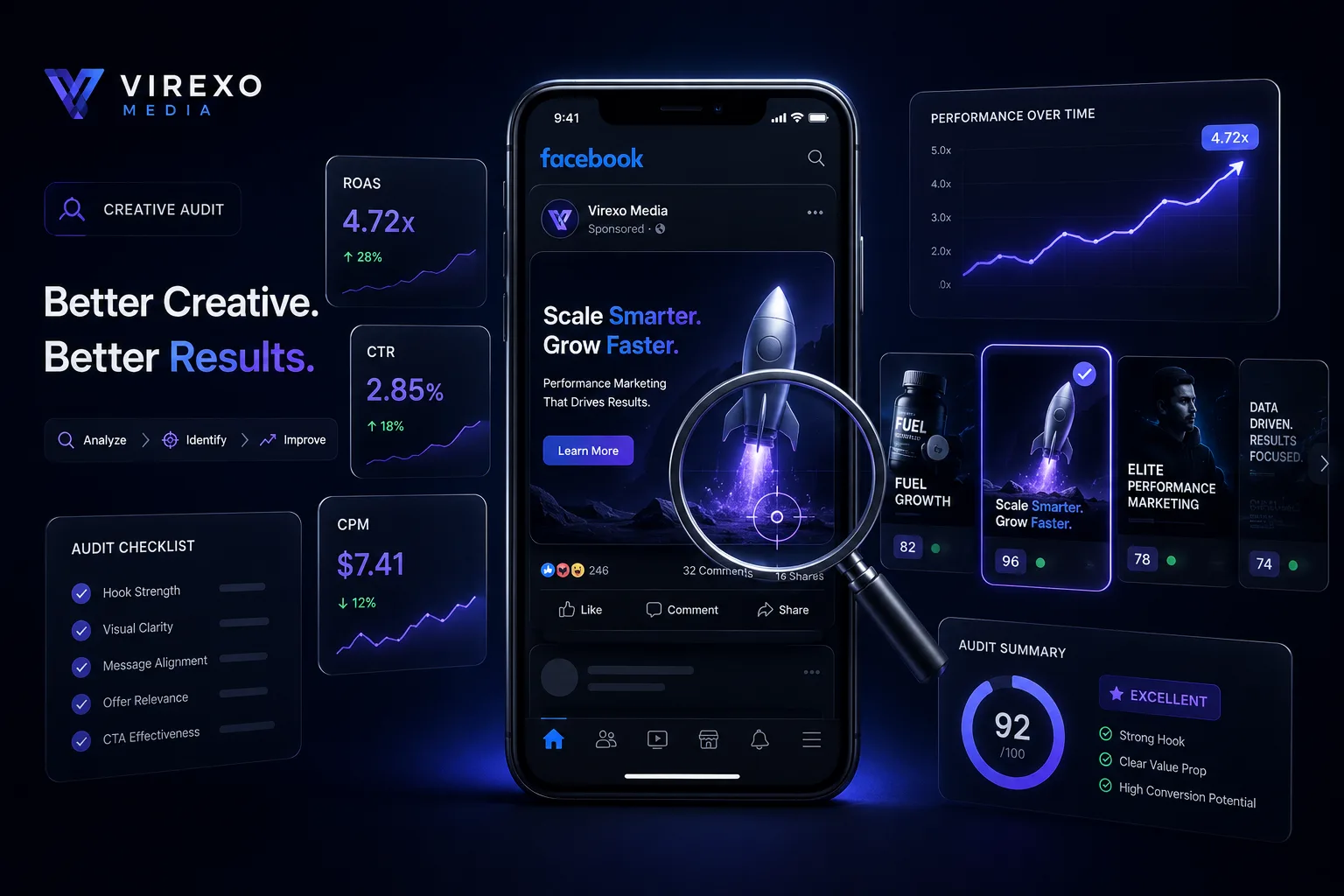
Prefer the printable version? Download the free Meta Ads Creative Audit (PDF)—the 12-point checklist and placement cheat sheet on one page you can keep open while you audit your ads.
What's inside this audit
- Why creative—not budget or targeting—is the lever that moves ROAS in 2026
- The 5 creative mistakes that quietly drain ad performance, with the fix for each
- A 12-point creative audit to score your current ads honestly
- A placement and format cheat sheet (the ratios and safe zones stores get wrong)
- 5 quick wins you can ship this week
Your budget probably isn't the problem
Meta's 2026 "Andromeda" overhaul made your creative the primary signal the system uses to find buyers. Targeting and budget still matter, but the algorithm now reads the ad itself—the hook, the format, the offer—to decide who sees it. Treat creative as decoration and you're optimizing the wrong lever. The upside: creative is the part you fully control.
Here's where the 2026 ecommerce benchmarks sit, so you have a sanity check before you judge your own numbers:
| Metric | 2026 median |
|---|---|
| ROAS | 1.9–3.4× |
| CPA | $30–$38 |
| CTR | ~2.2% |
| CPM | ~$13.50 |
These are industry medians (sources: 27five, Triple Whale, Ryze, 2026)—a sanity check, not a target or a guarantee. Your margin and average order value decide what "good" actually means for you.
The 5 mistakes quietly killing your ROAS
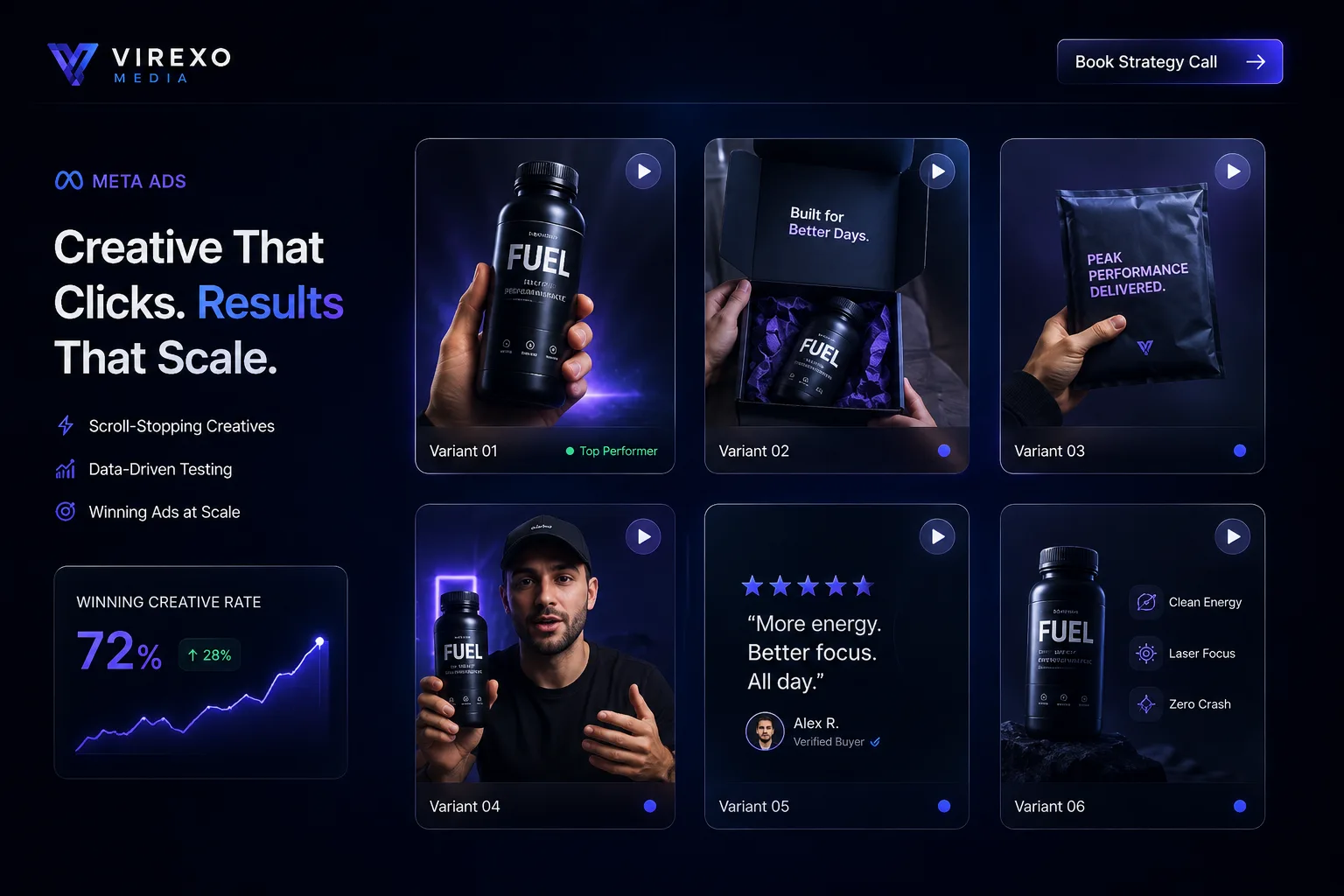
1. Your ads look like ads
Studio-lit, logo-forward, perfectly polished "campaign" creative pattern-matches as an ad in the first 1.5 seconds—and gets scrolled. Fix: make it feed-native. Product on a real counter, a quick phone clip, a hand holding the package, sticky-note overlays. Creative that looks like organic content earns attention before the viewer decides to scroll past.
2. One size, every placement
Uploading a single 1:1 or landscape asset and running it everywhere gets the wrong ratios letterboxed, screams "ad," and quietly raises your CPM. Fix: build to the placement—4:5 for Feed, 9:16 for Stories and Reels—and keep text and logos out of the top and bottom unsafe zones so nothing important gets covered by the UI.
3. Too few creatives
Launching 2–3 ads and calling it a test is creative underinvestment, and it's the most common reason accounts stall at scale—not targeting. Fix: ship in concepts, not one-offs. Aim for a handful of distinct angles (problem, proof, offer, demo, founder story), each in 2–3 formats, every refresh cycle.
4. Set-and-forget fatigue and messy tests
Running one winner until performance bleeds out—or changing audience, creative, and budget all at once so you can never tell what moved the number. Fix: watch frequency and 3-second hold rate and refresh before fatigue sets in. Change one variable at a time so the result is actually readable.
5. No clear offer, weak hook, mismatched page
Pretty ads with no reason to act, a hook that arrives at second four, and a click that lands on a generic homepage. Fix: lead with the offer in the first 1.5 seconds, make the hook a real pain or concrete outcome, and send the click to a page that repeats the exact promise. Message match beats most targeting tweaks.
Rule of thumb: if you can't tell within three seconds what's being sold and why it matters to you, neither can your customer—or the algorithm.
The 12-point creative audit
Score your current ads honestly. Anything you can't check off is your highest-leverage fix this week.
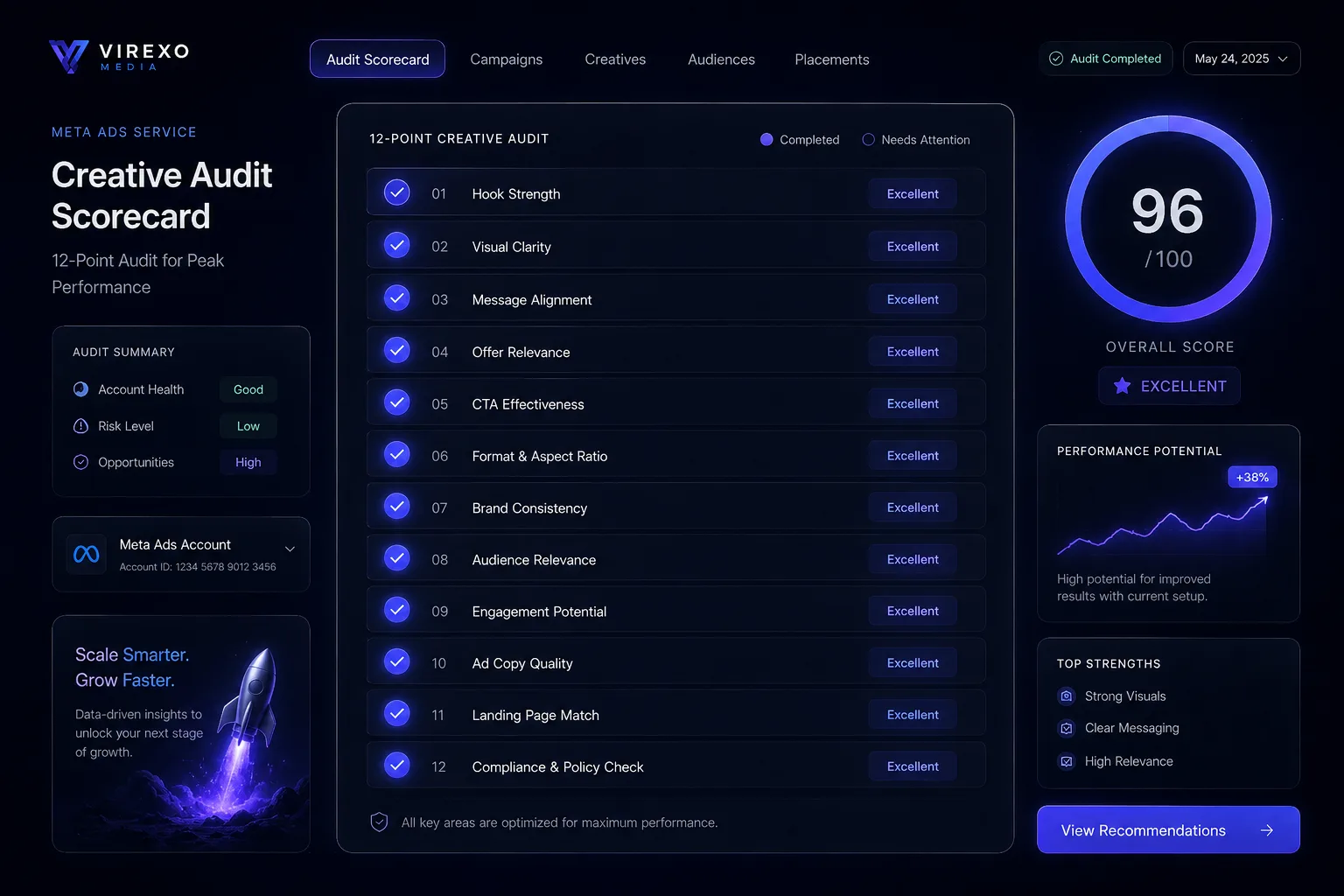
- The first 1.5 seconds shows the product, the hook, or the offer—not a logo intro.
- The ad could pass as organic content in the feed.
- It's built natively in 4:5 (Feed) and 9:16 (Stories/Reels).
- Critical text and logos sit inside the safe zone (top and bottom kept clear of the UI).
- On-screen captions are on—most feed views are muted.
- At least 4–5 distinct concepts are live, not variations of one.
- Each concept covers a different angle: problem, proof, offer, demo, founder.
- A clear, specific offer appears on the creative itself.
- The hook names a real pain or concrete outcome in the first line.
- One variable changes per test, and a naming convention keeps results readable.
- Frequency is monitored and fatigued creatives are refreshed on a set cadence.
- The destination page repeats the ad's exact promise (message match).
Placement and format cheat sheet
Build vertical-first and crop up, not down. Keep the subject and any critical text inside the safe zones below so the platform UI never covers them.
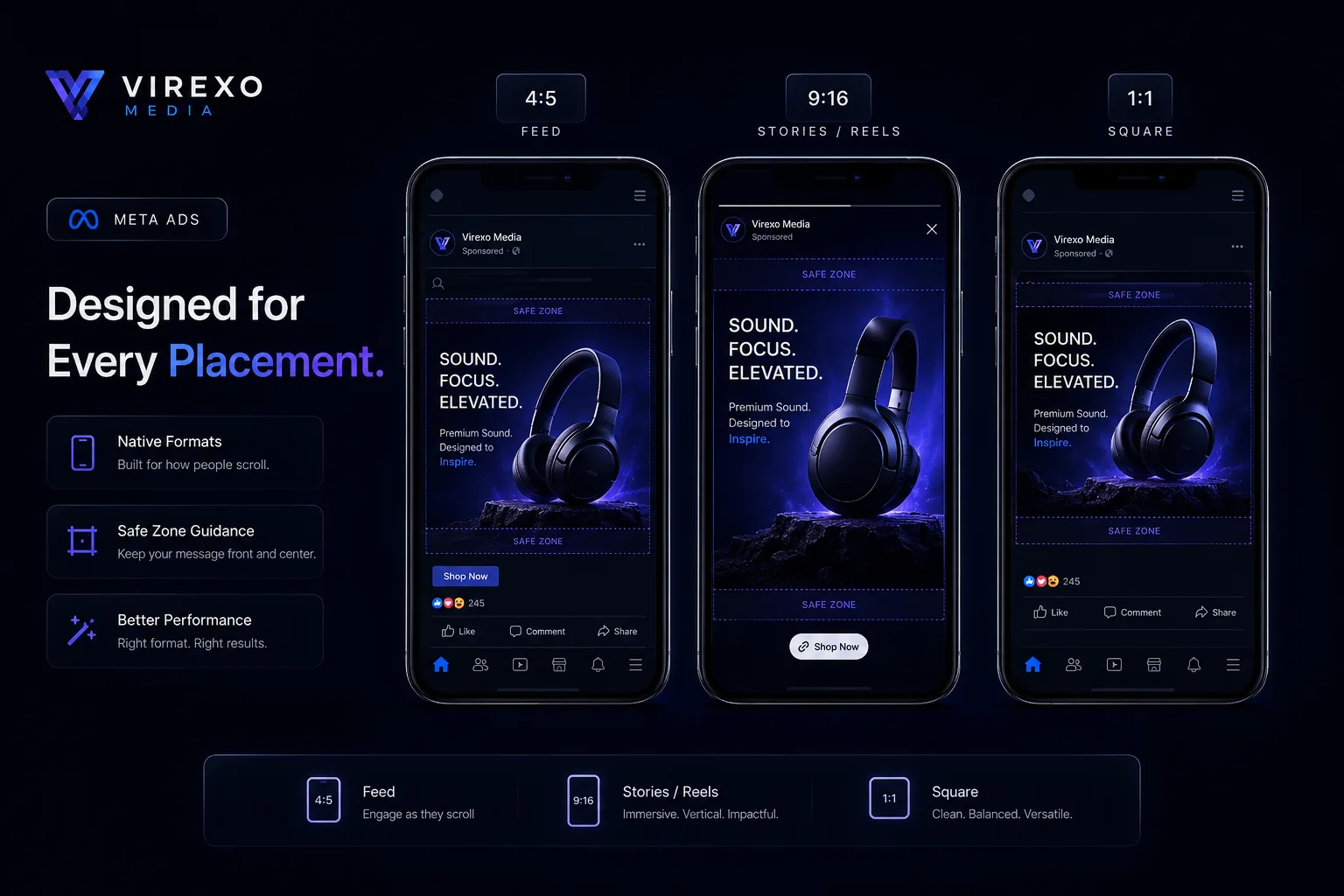
| Placement | Ratio | Best for | Keep clear |
|---|---|---|---|
| Feed (FB & IG) | 4:5 | Primary conversions | ~14% top & bottom |
| Stories | 9:16 | Full-screen immersion | ~14% top / ~20% bottom |
| Reels | 9:16 | Cheap reach + discovery | ~20% bottom (UI + caption) |
| Right column / search | 1:1 | Supplemental | center the subject |
Video under ~15 seconds consistently leads engagement for ecommerce. When in doubt, go vertical.
5 quick wins you can ship this week
- Turn your 3 best organic posts or UGC clips into ads—native, and already proven.
- Add bold, readable captions to every video.
- Re-export your top creative natively in 4:5 and 9:16.
- Write 3 new hooks, each naming a different customer pain.
- Point every ad at a landing page that mirrors its exact promise.
Want it all on one page? Download the free Meta Ads Creative Audit (PDF) and score your account against the 12 points.
Common pitfalls to avoid
- Boosting posts and calling it a strategy.
- Judging a creative on day one—let the data settle.
- Killing winners by editing them mid-flight (duplicate instead).
- "Brand" videos with no offer and no reason to act.
- Beautiful ads pointing at a broken mobile landing page.
What good looks like
Illustrative example—hypothetical, to show the method. A Shopify store spending ~$15k/month on Meta is stuck near the bottom of the ROAS range with three polished video ads. They rebuild around five native concepts—UGC unboxing, founder story, problem/solution, offer, review wall—ship each in 4:5 and 9:16, add captions, and match every ad to a dedicated landing page. Over a few refresh cycles, hook rate and CTR climb and blended ROAS moves toward the benchmark range. The point isn't the numbers (those are hypothetical)—it's the method: native concepts, correct placements, structured testing, and message match.
How Virexo Media helps with Meta ads creative
Knowing the audit is one thing; producing native concepts, shipping them in the right placements, testing them cleanly, and matching each to a landing page is the daily work most teams don't have time for. That's exactly what our performance marketing team does—built around UGC and creative that doesn't look like an ad, structured testing, and retargeting that doesn't waste spend.
For context on the benchmarks above: across our ecommerce campaigns we average a 5.2x ROAS, with 200+ campaigns managed, $2.4M+ in revenue scaled, and 80+ clients served.
"Virexo Media completely transformed our Meta Ads strategy. We went from burning budget to a consistent 6x ROAS within three months. Their data-driven approach is unmatched."
— Sarah Mitchell, Founder, StyleHaus (USA)
Frequently asked questions
What is a Meta ads creative audit?
It's a structured review of your Facebook and Instagram ad creative—hook, format, offer, placements, testing setup, and landing-page match—to find what's holding back ROAS. This guide gives you a 12-point version you can run on your own account in an afternoon.
Why does creative matter more than targeting in 2026?
Meta's "Andromeda" system reads the ad itself—the hook, format, and offer—as the primary signal for who should see it. With detailed manual targeting playing a smaller role than it used to, your creative is now the main lever you control to reach the right buyers.
What ad sizes should I use for Meta ads?
Build natively per placement: 4:5 for Feed, 9:16 for Stories and Reels, and 1:1 for right-column and search. Keep critical text and logos inside the safe zones (roughly the top ~14% and bottom ~14–20%) so the UI never covers them.
How many ad creatives should I test at once?
Aim for at least 4–5 distinct concepts—each a different angle like problem, proof, offer, demo, or founder story—shipped in 2–3 formats. Two or three near-identical ads isn't a real test, and creative underinvestment is the most common reason accounts stall.
How do I know if my creative has fatigued?
Watch for rising frequency alongside a falling 3-second hold rate and CTR—that combination means people have seen it too often and stopped engaging. Refresh on a set cadence before the decline shows up in ROAS, and duplicate winners rather than editing them mid-flight.
What's a good ROAS for Meta ads?
2026 industry medians land around 1.9–3.4× (per 27five, Triple Whale, and Ryze), but that's a sanity check, not a target. Your margin and average order value decide what's actually profitable—a high-AOV brand can thrive at a lower ROAS than a thin-margin one.
Ready to ship creative that doesn't look like an ad?
Virexo Media builds and scales Facebook and Instagram ad creative for D2C and Shopify brands—native concepts, correct placements, structured testing, and landing pages that match the promise. Book a free strategy call and we'll review your ad account and tell you the first three things we'd fix.
Explore our performance marketing, website development, and content creation pages.
Want a free audit of your store?
Book a 15-minute call with Virexo Media. We'll review your Shopify site, ads, or SEO — and send a prioritized action list within 48 hours. No pitch deck. Just clarity.