July 4th Sale Playbook for Shopify Stores (2026)
Run a profitable July 4th sale on Shopify: a margin-safe offer, tasteful store theming, honest urgency, the 3 emails that drive revenue, and retargeting.
July 4th is a real revenue moment—if you run it as a campaign, not a random discount that eats your margin. This July 4th sale playbook shows Shopify and D2C stores how to build a profitable Independence Day sale: a margin-safe offer, tasteful theming, honest urgency, the three emails that drive most of the revenue, and the retargeting that makes it pay. And 2026 is America's 250th anniversary—the biggest Independence Day shopping moment in a generation—so it's worth doing right. It's the same campaign system our team runs on Meta ads and Shopify builds for clients.
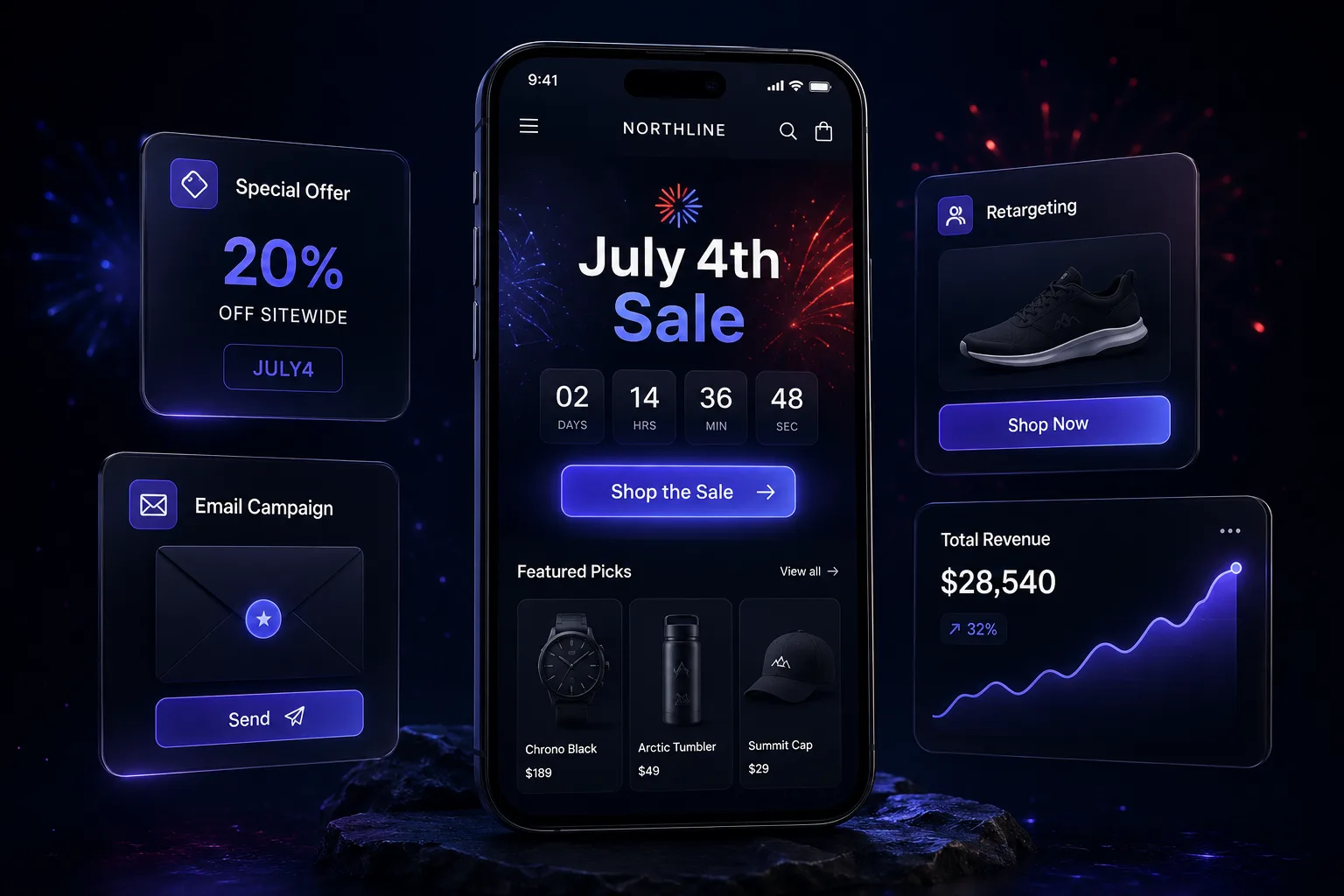
Prefer the printable version? Download the free July 4th Sale Playbook (PDF)—the full 6-step campaign on one page.
What's inside this playbook
- How to build an offer that moves product without erasing your margin
- How to theme the store tastefully (and what to avoid)
- The honest way to stack urgency
- The 3 emails that drive most of a sale's revenue
- How to retarget window shoppers and win the day after
Step 1 — Build an offer that protects margin
The goal isn't the deepest discount—it's the offer that moves the most product while keeping you profitable. Pick one structure and commit:
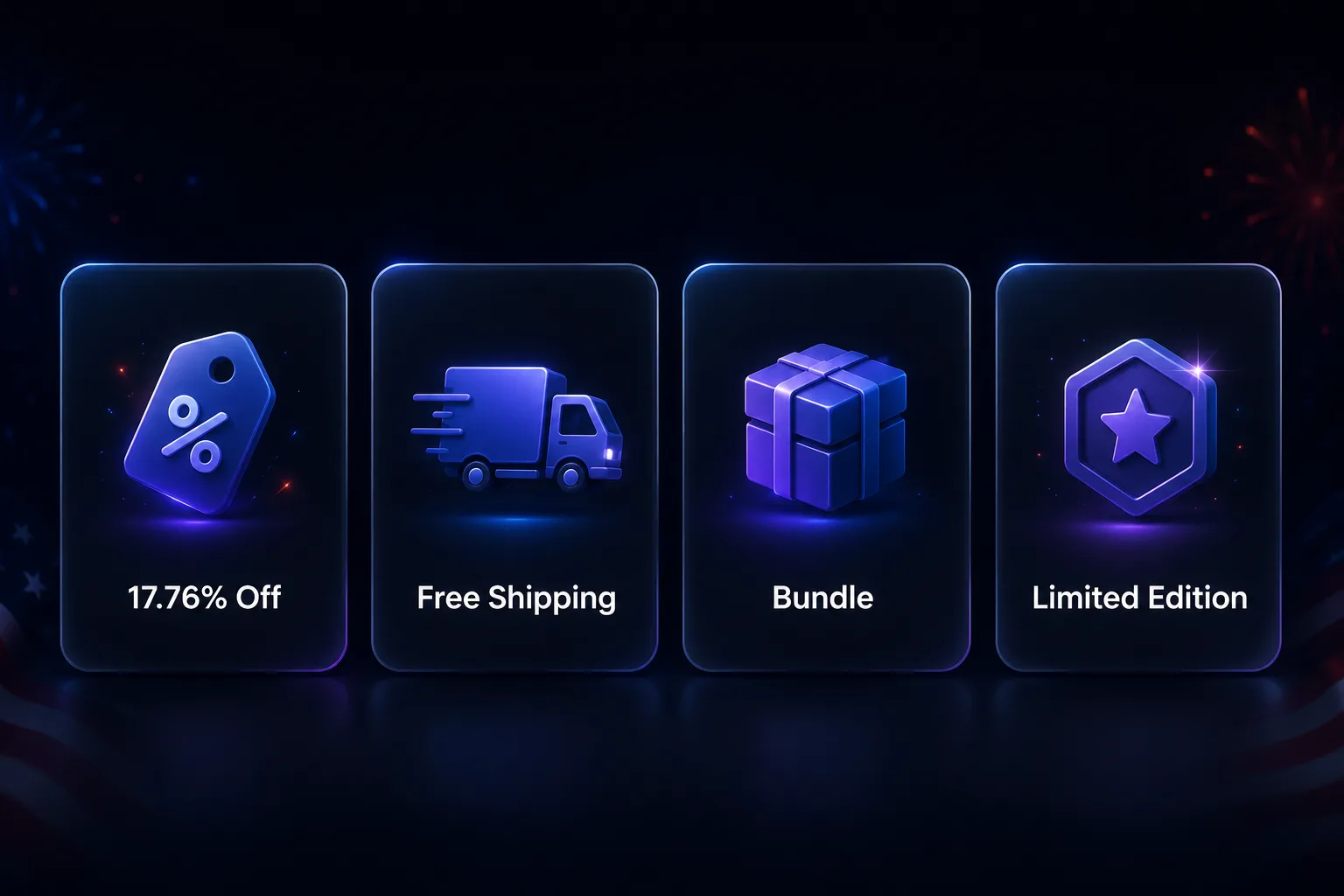
- Themed % off — a "17.76% off" nod to 1776 is memorable and on-theme without screaming "race to the bottom."
- Free-shipping threshold — shipping cost is a top cart-abandon reason; a free-ship-over-$X bar lifts average order value.
- Bundle / tiered — "spend more, save more" protects margin better than a flat sitewide cut.
- Limited edition / curated collection — a small July 4th collection creates urgency and exclusivity.
Margin check: before you publish, run the math. If your product costs $18 and sells at $50, a 25% off code (−$12.50) still leaves you $19.50 gross—fine. A 40% code (−$20) leaves $12. Know your floor before the fireworks start.
Step 2 — Theme the store (tasteful, not tacky)
Patriotic energy works—clutter doesn't. Add a homepage hero banner announcing the sale and its end date, a single themed accent color, and a clear collection link. Keep your product pages clean and fast; a slow, busy store loses the sale you just paid to attract.
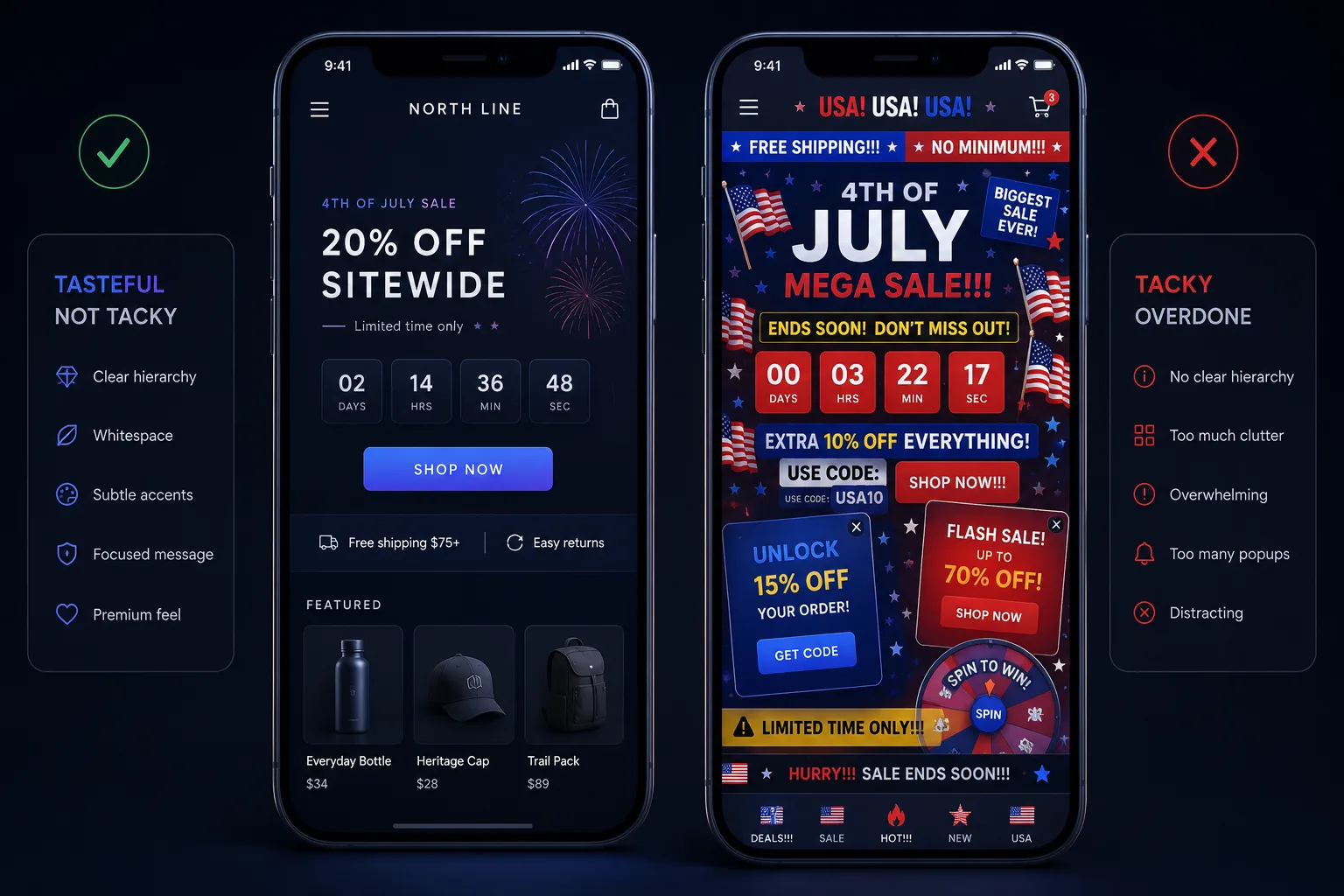
Do: one clear sale banner + countdown, fast mobile pages, a curated collection link in the nav. Not that: flag GIFs everywhere, three competing pop-ups, and a checkout that still has five form fields. (If checkout is shaky, fix it first with the cart-recovery playbook.)
Step 3 — Stack urgency the honest way
- A countdown timer on the sale and product pages showing the real end date.
- A genuine cutoff for guaranteed delivery before the holiday.
- "While supplies last" only when it's true—fake scarcity gets punished by both customers and platforms.
Step 4 — The 3 emails that drive most of the revenue
| When | Job | |
|---|---|---|
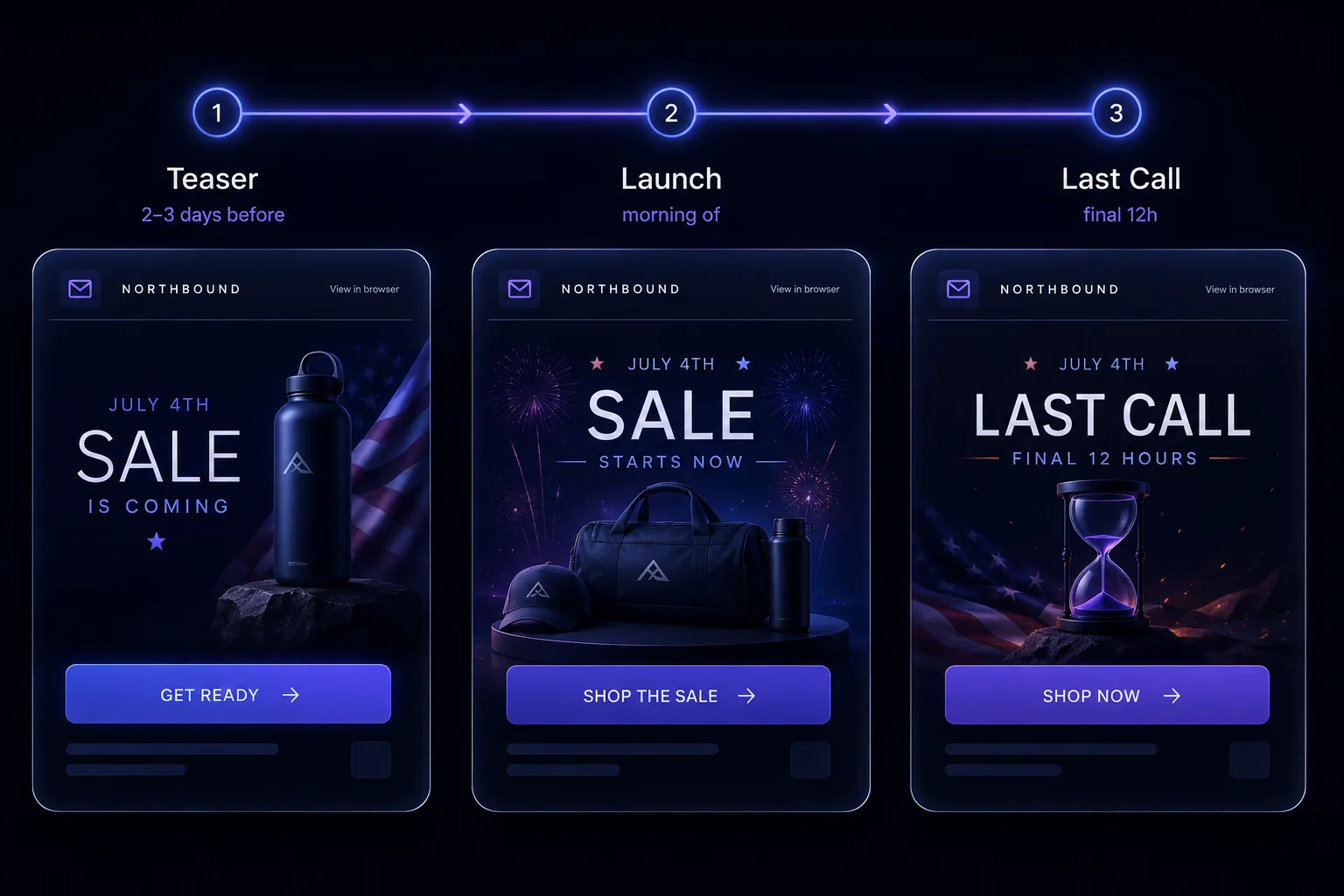
| Teaser | 2–3 days before | Build anticipation, hint at the offer, ask them to reply or save the date |
| Launch | Morning of | Clear offer, hero product, one strong CTA button—keep it short |
| Last call | Final ~12 hours | Urgency + objection-handling; this often outperforms the launch email |
Quick win: segment out the people who clicked but didn't buy and send them a dedicated "last call" featuring the single product they viewed. Small list, high intent, big return. (Your email automation flows make this easy.)
Step 5 — Retarget the window shoppers
Most of your sale traffic won't buy on the first visit. Run Meta/Instagram + Google retargeting to people who viewed products or added to cart but didn't check out—show them the exact product and the sale deadline. This is usually the cheapest, highest-ROAS spend of the whole campaign. (See our seasonal Meta ads guide.)
"The sale doesn't end when the discount does—the follow-up is where the margin hides."
Step 6 — Win the day after
- Send a thank-you + post-sale flow to new buyers to turn one-time deal-seekers into repeat customers.
- Trigger a win-back offer to non-buyers within 72 hours, while intent is warm.
- Log what sold, at what margin, and which channel drove it—that's your BFCM head start.
Common mistakes to avoid
- Discounting everything sitewide and erasing your margin.
- Launching the offer with no email warm-up or retargeting behind it.
- A themed homepage but a slow, clunky mobile checkout.
- No delivery cutoff, so support drowns in "will it arrive in time?" tickets.
- Treating July 4th as one-and-done instead of a list-building and repeat-purchase moment.
What good looks like
Illustrative example—hypothetical, for direction only. A skincare store doing ~$40k/month plans a 5-day July 4th sale. Offer: free shipping over $45 + a curated "Summer Set" bundle. They warm the list with a teaser, launch on the morning of the 1st, and run last-call emails plus product-view retargeting. The pattern they'd expect: a higher average order value from the bundle and free-ship bar, and a meaningfully better return on the retargeting spend than cold ads—because the audience already raised their hand. The point isn't the exact numbers; it's the structure: one clear offer, warm the list, theme lightly, stack honest urgency, and let retargeting and follow-up do the heavy lifting.
How Virexo Media helps run your July 4th campaign
Planning the offer is step one; building the themed store, writing the email sequence, and running the retargeting—on a deadline—is the work. Our team builds and optimizes the full ecommerce growth stack for D2C and Shopify brands: store design and CRO, Meta/Instagram ads, and email and content. If you'd rather have your July 4th campaign planned, built, and run by a team that does this every day, that's exactly what we do.
The numbers behind the work: 80+ clients served, 200+ campaigns managed, $2.4M+ in revenue scaled, and a 5.2x average ROAS across our ecommerce campaigns.
"Virexo Media completely transformed our Meta Ads strategy. We went from burning budget to a consistent 6x ROAS within three months. Their data-driven approach is unmatched."
— Sarah Mitchell, Founder, StyleHaus (USA)
Frequently asked questions
What's the best July 4th sale offer for a Shopify store?
Pick one structure that protects margin: a themed percentage (a "17.76% off" nod to 1776), a free-shipping threshold, a "spend more, save more" bundle, or a small limited-edition collection. A flat sitewide discount is the easiest way to erase your profit—avoid it.
How deep should my July 4th discount be?
Deep enough to move product, shallow enough to stay profitable. Run the margin math first: if a product costs $18 and sells at $50, a 25% code still leaves ~$19.50 gross, while a 40% code leaves $12. Know your floor before you publish the offer.
How many emails should I send for a sale?
Three do most of the work: a teaser 2–3 days before, a launch email the morning of, and a last-call email in the final ~12 hours. The last-call often outperforms the launch, especially when you segment people who clicked but didn't buy.
When should I start my July 4th campaign?
Warm your list 2–3 days ahead with a teaser so the launch lands on a primed audience. Behind the scenes, set the themed collection, countdown, and a guaranteed-delivery cutoff before you go live.
What's the highest-ROI spend during a sale?
Retargeting window shoppers—people who viewed products or added to cart but didn't check out. Showing them the exact product plus the sale deadline is usually the cheapest, highest-ROAS spend of the whole campaign, because they already raised their hand.
Ready to make July 4th a real revenue moment?
Virexo Media plans, builds, and runs profitable ecommerce sales campaigns for D2C and Shopify brands—store, email, and ads in one place. Book a free strategy call and we'll map your July 4th campaign and the fastest path to more sales.
Explore our website development, performance marketing, and content creation pages.
Want a free audit of your store?
Book a 15-minute call with Virexo Media. We'll review your Shopify site, ads, or SEO — and send a prioritized action list within 48 hours. No pitch deck. Just clarity.