Shopify Abandoned Cart Recovery: How to Win Back the 70% Who Leave
How to recover abandoned carts on Shopify: the 7 real reasons buyers bail, a 12-point checkout audit, and a 3-message recovery flow with timing you can ship this week.
You don't have a traffic problem—you have a leak. Across 50 studies, the average online cart is abandoned 70.22% of the time (Baymard Institute), and most of that is fixable design and friction, not lost demand. This Shopify cart recovery guide gives you the 7 real reasons buyers bail, a 12-point checkout audit, and a 3-message recovery flow you can ship this week—so you plug the leaks before you spend another dollar on ads. It's the same work our team does on Shopify store and checkout builds.
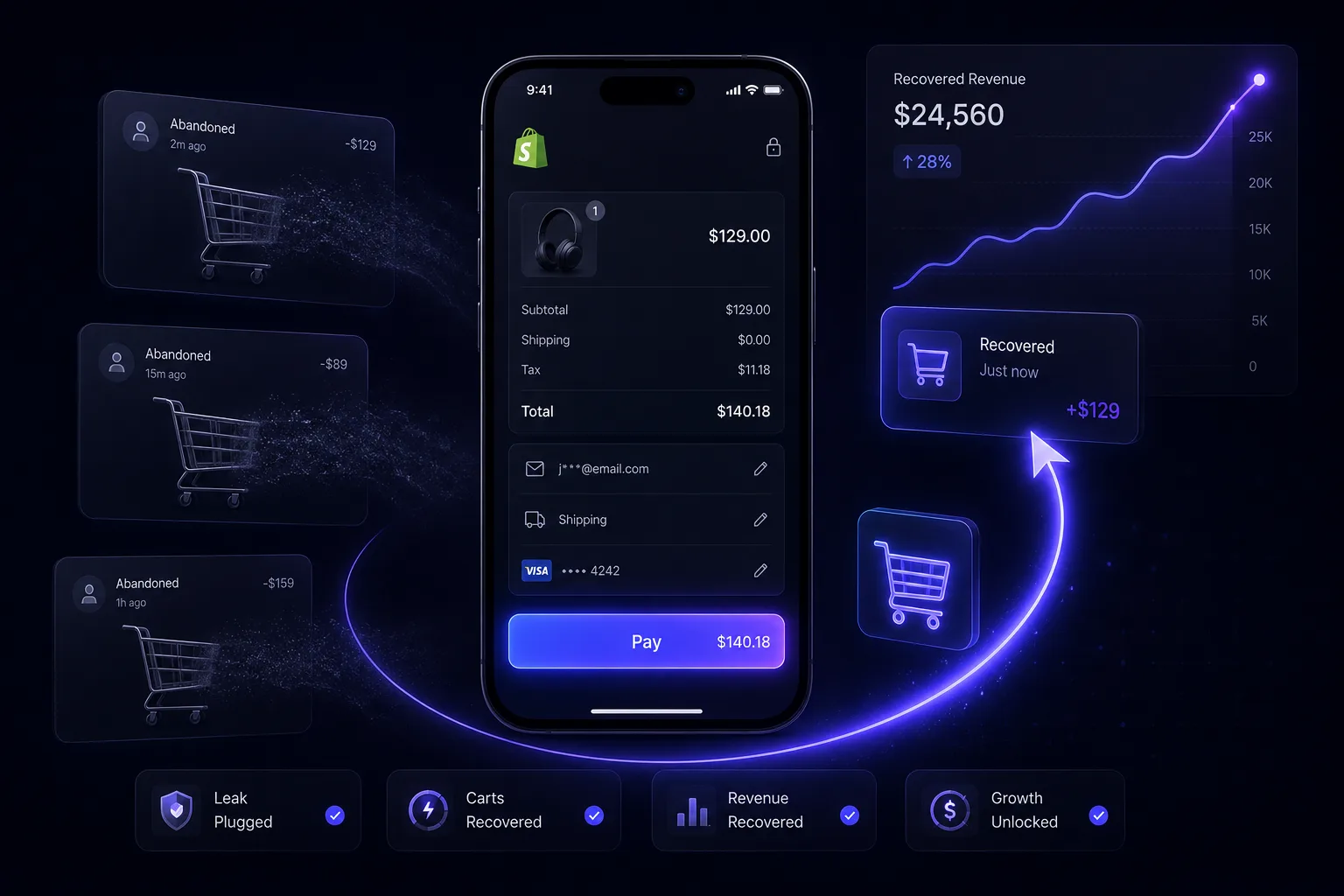
Prefer the printable version? Download the free Shopify Checkout & Cart-Recovery Checklist (PDF)—the 12-point audit and the 3-message flow on one page you can work through today.
What's inside this checklist
- Why ~70% of carts are abandoned—and how much of it is fixable
- The 7 real reasons buyers bail at checkout, each with the fix
- A 12-point checkout audit to run on your own phone right now
- A 3-message cart-recovery flow that protects your margin
- Quick wins you can ship in one afternoon
You don't have a traffic problem. You have a leak.
When you see plenty of "add to cart" but not enough "order placed," the instinct is to buy more traffic. But if seven in ten carts leak out at checkout, every new visitor leaks at the same rate—you're just paying to fill a bucket with holes. Fix the checkout first and every future visitor (and every dollar of ad spend) converts better. The recovered carts are revenue you already paid to acquire.
The 7 real reasons buyers bail—and the fix
When Baymard asked shoppers why they abandoned, the top answers were rarely "I changed my mind." They were friction. Here's each one, with the move that fixes it.
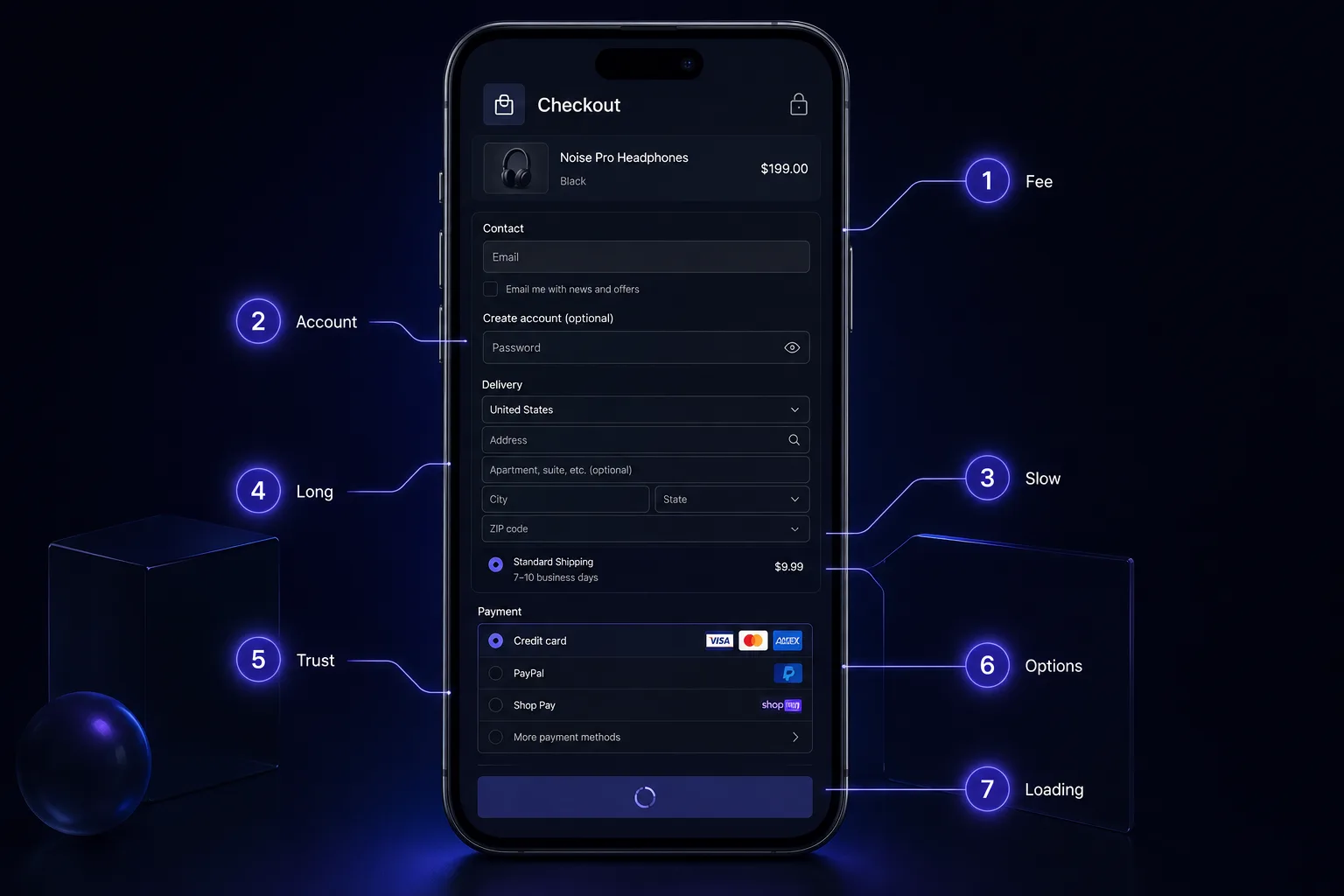
| Why they leave | Share | What to do instead |
|---|---|---|
| Surprise extra costs (shipping, tax, fees at the end) | ~48% | Show shipping & tax early; add a free-shipping threshold—no surprises at the final step |
| Forced to create an account | ~25% | Turn on guest checkout (Settings → Checkout); offer account creation after purchase |
| Slow or unclear delivery | ~24% | Show delivery dates and an ETA on the product and cart page—certainty beats speed |
| Long, complicated checkout | — | Cut fields to the essentials, enable address autocomplete, use one-page checkout |
| Don't trust the site with card details | — | Add trust badges, a visible returns policy, reviews, and known payment logos near the pay button |
| Can't see the total / no preferred payment | — | Show the order total early; offer Shop Pay, Apple/Google Pay, PayPal, and a BNPL option |
| Site or mobile too slow or buggy | — | Compress images, trim apps & scripts, and test on a real phone on cellular data |
Percentages: Baymard Institute checkout survey. Shoppers select multiple reasons, so they sum to more than 100%.
The 12-point checkout audit
Open your store on your phone and walk your own checkout. Check off every box—each unchecked item is money on the floor.
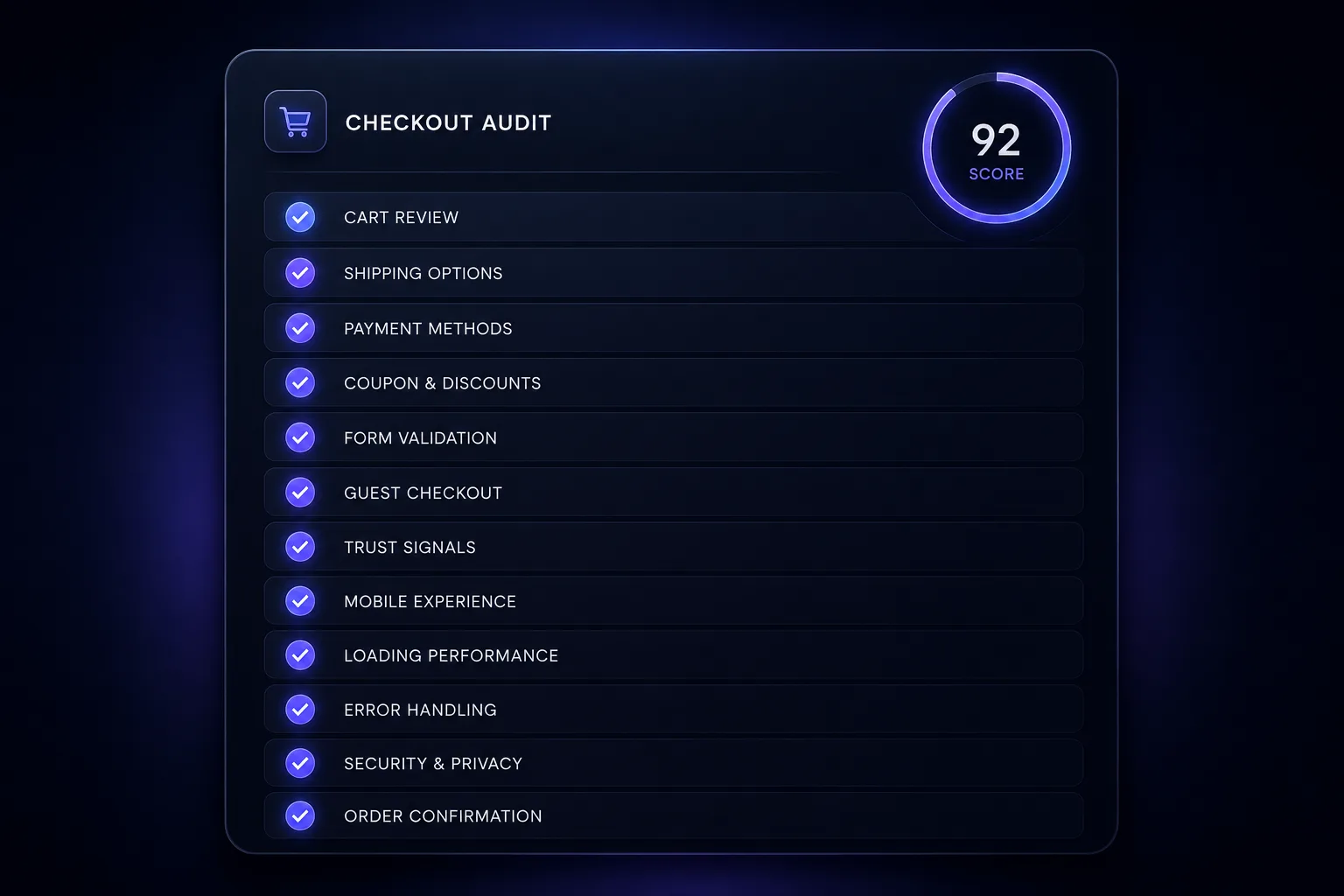
- Free-shipping threshold shown in cart ("You're $14 away")
- Shipping & tax estimate visible before the final step
- Guest checkout enabled—no forced account
- Express wallets up top (Shop Pay, Apple/Google Pay, PayPal)
- One-page, single-column checkout flow
- Address autocomplete turned on
- Minimal fields, with a numeric keypad for number inputs on mobile
- Trust signals beside the pay button (secure, returns)
- Cart editable in place—quantity, remove, promo
- Discount field present, but not so loud it sends people code-hunting
- Inline, human errors ("Card number looks short")
- Mobile-first: thumb-friendly, fast, with a sticky "Pay" button
Rule of thumb: every extra field, click, and surprise between "Add to Cart" and "Pay" costs you orders. Remove, don't add.
The 3-message cart-recovery flow
For the carts that still slip through, a simple sequence brings a share of them back. Lead with helpfulness, not discounts—protect your margin. (This is the abandoned-cart piece of a fuller email flow setup.)
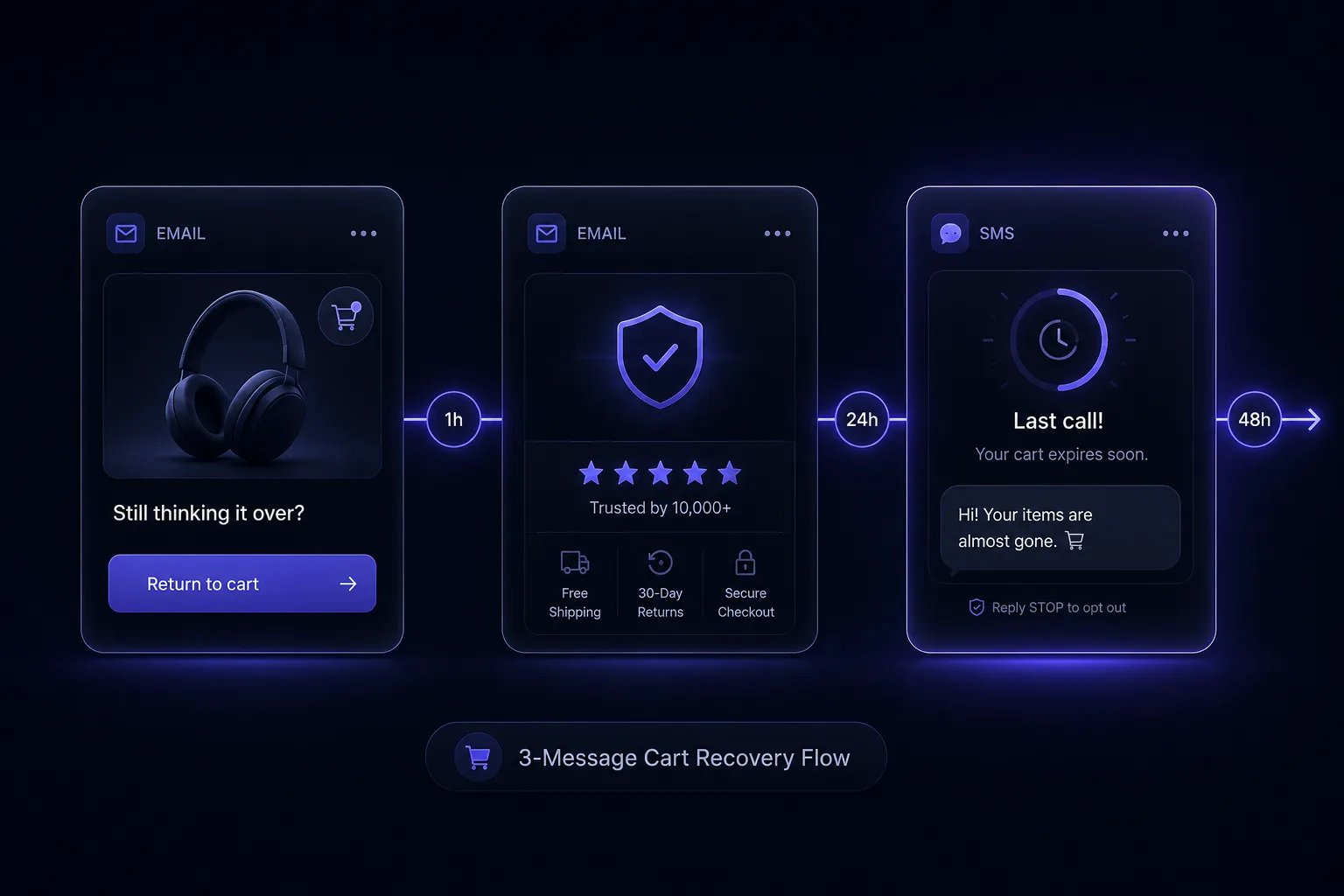
Email 1 — "You left something behind" (~1 hour)
A friendly nudge with the product image and a one-click link straight back to the cart. No discount yet—many people just got interrupted and only need the reminder.
Email 2 — Handle the objection (~24 hours)
Answer the silent "why not?": shipping, easy returns, security, and a couple of real reviews. Add a modest incentive only if your margins allow it.
Email 3 — Last call (~48–72 hours)
Light, honest urgency (cart expiring, or low stock if it's true) plus your single strongest reason to buy. Add an SMS for opted-in subscribers to lift recovery further.
Recovery flows recapture a meaningful share of abandoned carts—the exact lift depends on your traffic, margin, and offer, so measure your own.
Quick wins you can ship in one afternoon
- Turn on guest checkout (5 minutes)
- Add a free-shipping bar
- Enable Shop Pay / Apple Pay in checkout
- Add a 3-badge trust strip under the buy button
- Set up Email 1 of the recovery flow
- Test checkout on your phone on cellular data
Want it all on one page? Download the free Checkout & Cart-Recovery Checklist (PDF) and tick each item off as you go.
Common mistakes to avoid
- Hiding shipping cost until the final step
- Forcing account creation to buy
- A giant discount field that trains people to leave and hunt for codes
- Stacking upsells and popups between cart and pay
- Slow, image-heavy mobile pages
- No recovery email at all—the biggest miss
What "good" looks like
Illustrative example—not a client result. A store doing ~$40k/month at a 1.8% conversion rate has surprise shipping, no guest checkout, and no recovery emails. They make three changes: show shipping early with a free-ship threshold, turn on guest checkout and Shop Pay, and launch the 3-email recovery flow. Baymard's testing shows checkout UX fixes can lift conversion by up to ~35%—and even a fraction of that compounds across every future visitor, while the recovered carts are revenue you already paid to acquire. The point isn't the exact number; it's that you measure your own before/after and keep the wins.
How Virexo Media helps with checkout and cart recovery
Auditing the checklist is the easy part—implementing it cleanly in your theme and wiring up the recovery flow is where the revenue actually shows up. That's the work our team does on Shopify development and CRO builds: we tighten the checkout, add trust and express payments, and set up the email/SMS flows that bring abandoned carts back. For the broader picture, see our checkout optimization guide.
The numbers behind the work: 80+ clients served, 50+ Shopify stores built, $2.4M+ in revenue scaled, and a 5.2x average ROAS across our ecommerce campaigns.
"Virexo Media rebuilt our entire website on React and ran our ad campaigns from scratch. Within two months we had a 4x return on ad spend and a site that actually converts."
— David Chen, Founder, DataPulse (Canada)
Frequently asked questions
How do I recover abandoned carts on Shopify?
Two layers. First, stop the abandonment you can prevent—show shipping costs early, enable guest checkout, turn on express payment buttons, and cut form fields (the 12-point audit above). Second, run a recovery flow: three messages at roughly 1 hour, 24 hours, and 48–72 hours, each linking straight back to the prefilled cart. Shopify has a built-in abandoned checkout email, but a dedicated email tool gives you proper sequencing and segmentation.
What's the difference between an abandoned cart and an abandoned checkout?
An abandoned cart means the shopper added an item but never started checkout. An abandoned checkout means they entered the checkout flow—usually giving you their email—and stopped before paying. Abandoned checkouts are far higher intent and worth a faster, more urgent sequence; Shopify only captures contact details once checkout has been started, which is why that segment is the one you can actually email.
Can I recover carts without offering a discount?
Yes, and you should try before discounting. Most abandonment is caused by friction and unanswered questions—surprise shipping costs, unclear returns, no trust signals—not by price. Lead with reassurance (free returns, delivery timing, reviews) in the first two messages and hold any incentive for the final one, if you use one at all. Discounting immediately trains shoppers to abandon on purpose.
What is a normal cart abandonment rate on Shopify?
Across 50 studies, Baymard Institute puts the average online cart abandonment rate at about 70%. That's the norm—so the goal isn't zero, it's removing the friction (surprise costs, forced accounts, slow checkout) that pushes your rate higher than it needs to be.
Why do shoppers abandon checkout?
The biggest reasons are friction, not lost intent: surprise shipping and fees at the end (~48%), being forced to create an account (~25%), slow or unclear delivery (~24%), a long checkout, distrust around card security, missing preferred payment options, and a slow or buggy mobile experience (Baymard checkout survey).
How do I reduce cart abandonment on Shopify?
Show shipping and tax early (ideally with a free-shipping threshold), enable guest checkout, put express wallets like Shop Pay up top, use a one-page checkout with minimal fields, add trust signals beside the pay button, and launch a cart-recovery email flow. Start with the quick wins—most take an afternoon.
How many cart-recovery emails should I send?
Three works well: a friendly reminder around an hour later, an objection-handling email at ~24 hours, and a last-call email at ~48–72 hours. Add an SMS for opted-in subscribers to lift recovery further.
Should cart-recovery emails include a discount?
Lead with helpfulness, not discounts—many people simply got interrupted and just need the reminder. Save any incentive for the second or third message, and only if your margins allow it, so you don't train customers to abandon on purpose.
Does guest checkout really matter?
Yes—about 25% of shoppers abandon because they're forced to create an account (Baymard). Turning on guest checkout in Settings → Checkout removes that barrier; you can still invite account creation after the purchase is complete.
Ready to stop the leak?
Virexo Media designs Shopify stores, optimizes checkout, and builds the email/SMS flows that turn browsers into buyers. Book a free strategy call and we'll walk your checkout, find the leaks, and send a prioritized action list within 48 hours.
Explore our website development, performance marketing, and SEO services pages.
Want a free audit of your store?
Book a 15-minute call with Virexo Media. We'll review your Shopify site, ads, or SEO — and send a prioritized action list within 48 hours. No pitch deck. Just clarity.