Ecommerce Email Templates: A Copy-and-Paste Swipe File
A free ecommerce email swipe file: ready-to-use subject lines and body copy for welcome, abandoned cart, browse, post-purchase, and win-back emails. Paste in and send today.
This page is a swipe file, not a strategy guide: below are ready-to-use subject lines and body copy you can paste straight into your email tool today. If you're still deciding which flows to build, what triggers them, and when each email should send, start with our Shopify email flows guide—then come back here for the words.
Email returns roughly $36 for every $1 spent, and about 2% of email volume drives ~37% of revenue when the right flows are automated (industry averages—Klaviyo and 2026 ecommerce email reports, not Virexo client results). The templates below cover all five core flows.
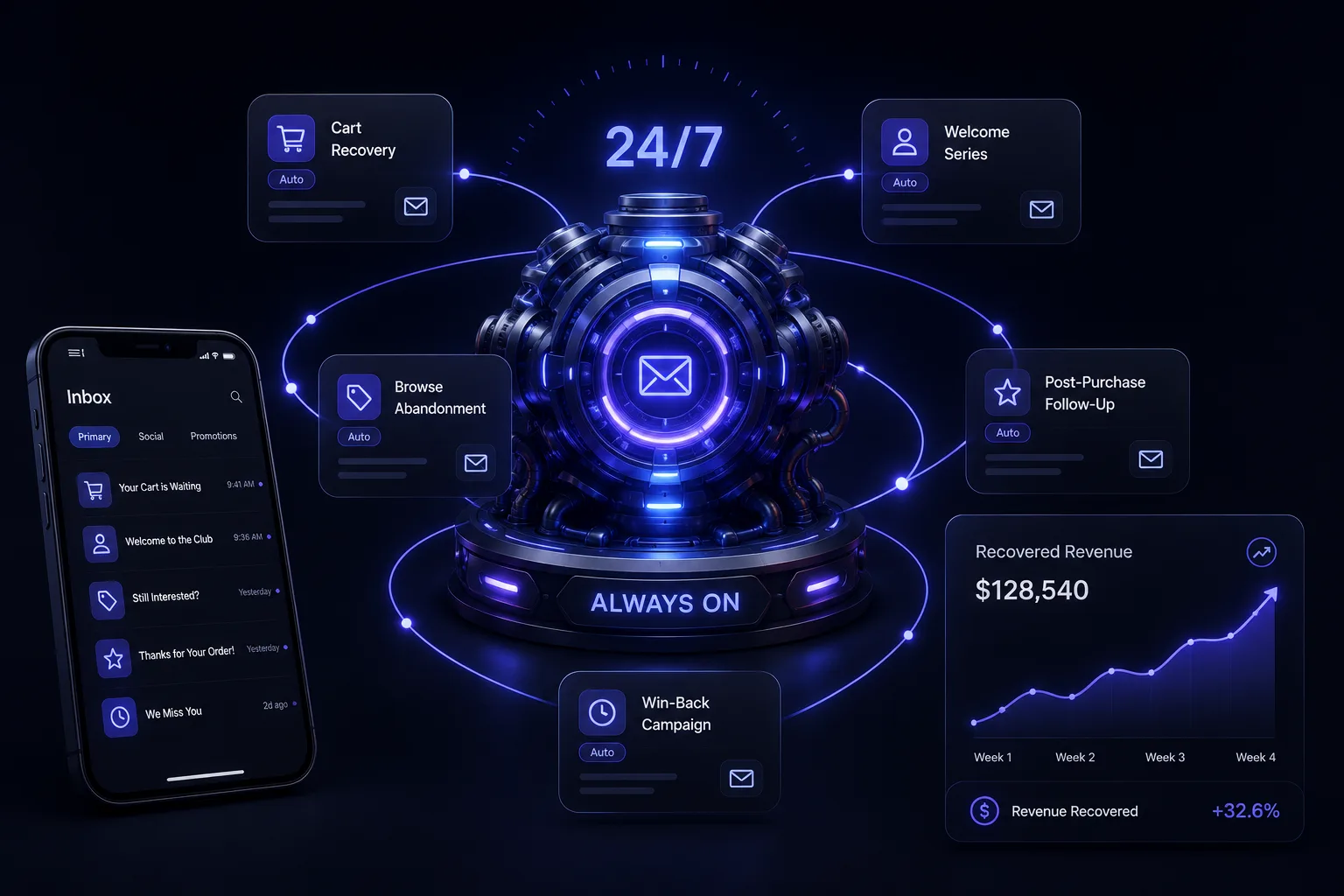
Prefer the printable version? Download the free Email Automation Swipe File (PDF)—all five flows and their copy templates on one page.
What's inside this swipe file
- The 5 automated flows every store should have running
- The exact trigger, timing, and email-by-email copy for each
- Why a 3-email cart flow beats a single reminder (and by how much)
- The common mistakes that quietly kill flow revenue
- A realistic "what good looks like" benchmark
The 5 flows every store should have running
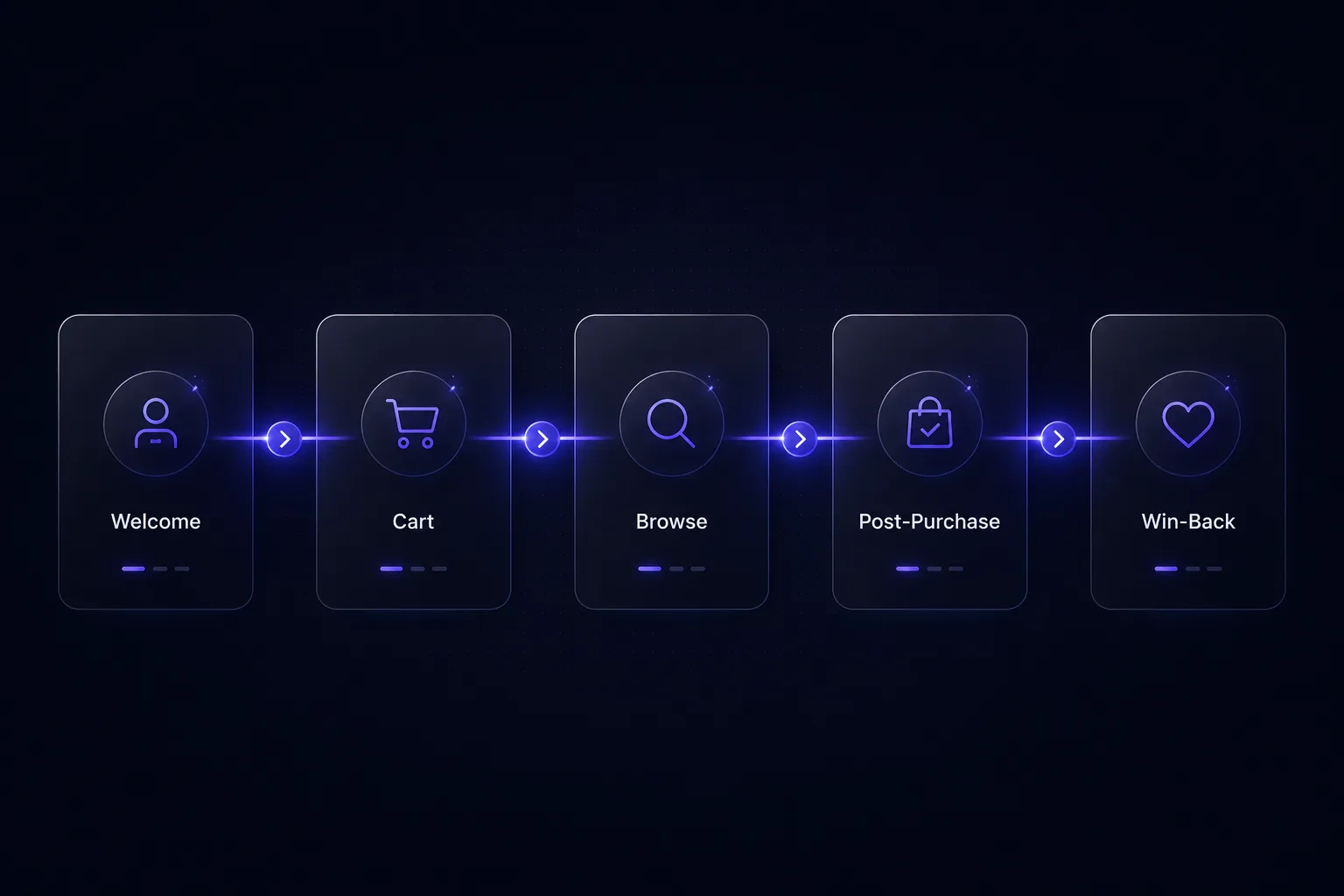
1. Welcome flow
Trigger: new email signup · 3 emails over 5 days. This is your highest-attention moment—new subscribers are warm, so greet them, set expectations, and make a first-purchase offer. Welcome emails average an 83.6% open rate, the highest of any flow.
- Email 1 (instant): "Welcome—here's your 10% off." Deliver the promised code plus your one-line brand story.
- Email 2 (day 2): Best-sellers and what makes you different (social proof).
- Email 3 (day 5): A gentle nudge—"Your code expires tonight."
2. Abandoned cart flow
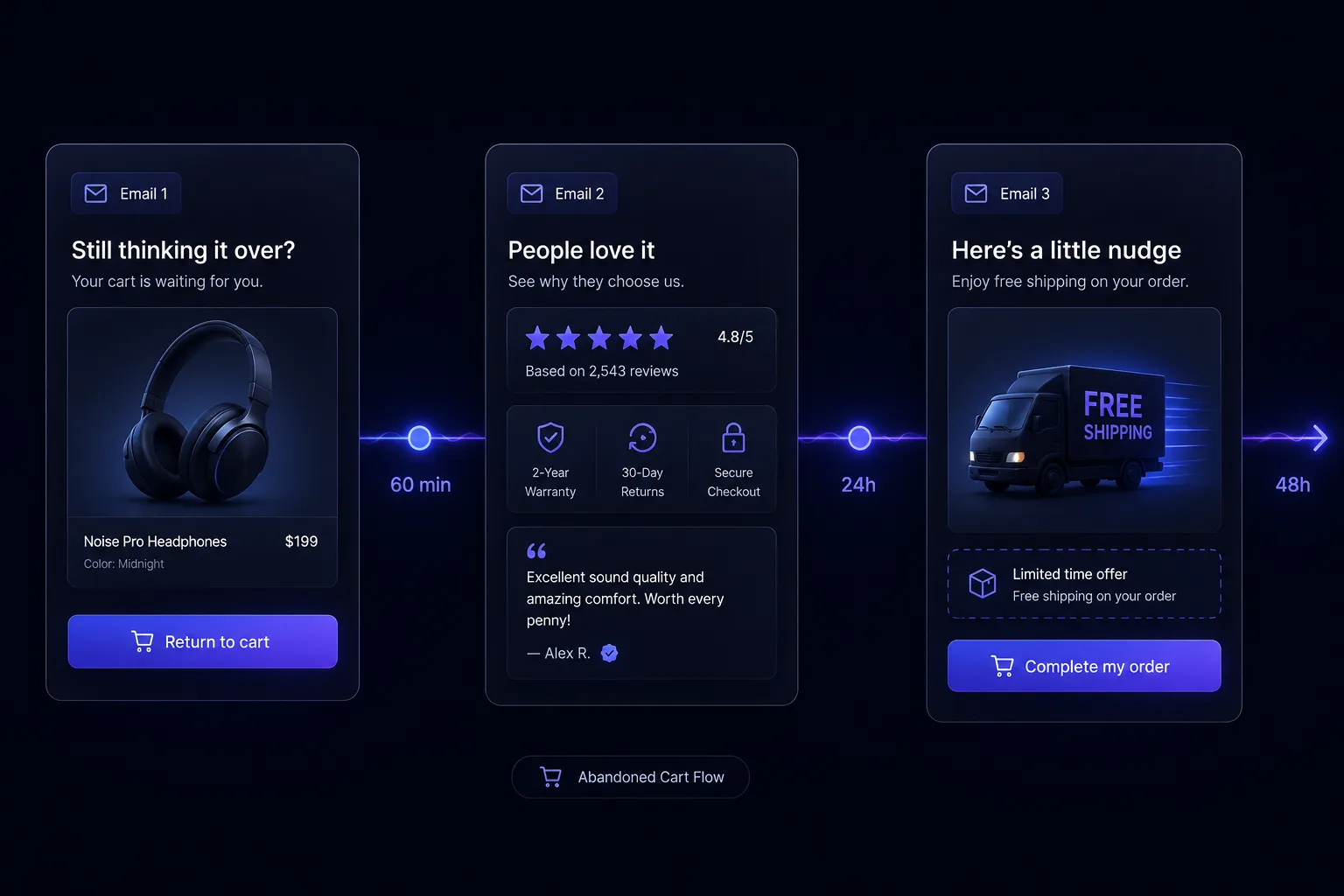
Trigger: cart created, not purchased · 3 emails over 24h. The single highest-leverage automation in ecommerce—they already chose the product, so remove the friction that stopped them. A 3-email sequence recovers ~6.5x more revenue than a single reminder.
- Email 1 (within 60 min): "You left something behind" + the exact item image. Sending within the hour recovers up to 3x more carts.
- Email 2 (~24h): Handle the objection—shipping, returns, a review.
- Email 3 (~48h): A light incentive (free shipping over a discount where possible).
3. Browse abandonment flow
Trigger: viewed product, no cart · 1–2 emails. Catches earlier-stage intent the cart flow misses—they looked but didn't add, so bring the product back into view.
- Email 1 (a few hours later): "Still thinking it over?" + the product they viewed and 2–3 related items.
- Email 2 (next day, optional): A benefit-led reason to come back (a key feature or a customer quote).
4. Post-purchase flow
Trigger: order placed · 2–3 emails over 2–3 weeks. Where one-time buyers become repeat buyers—reduce buyer's remorse, then earn the second order and the review.
- Email 1 (instant): Order confirmation + "here's what happens next."
- Email 2 (after delivery): How to get the most from it, and ask for a review.
- Email 3 (~3 weeks): A replenishment nudge or a relevant cross-sell.
5. Win-back flow
Trigger: no purchase in 60–90 days · 2 emails. Cheaper than acquiring a new customer—re-engage lapsed buyers before they forget you.
- Email 1: "We miss you" + what's new since they last shopped.
- Email 2: A final, stronger incentive with a clear deadline.
Want the templates on one page? Download the free swipe file (PDF) and paste each flow straight into your ESP.
Common mistakes that kill flow revenue
- Sending one abandoned-cart email instead of three—you leave most of the recovery on the table.
- Waiting hours (or a day) to send the first cart email instead of within ~60 minutes.
- Leading every email with a discount—it trains buyers to wait and erodes margin.
- Setting flows live once and never testing subject lines, timing, or offers.
- No post-purchase flow—so every order stays a one-time order.
What good looks like
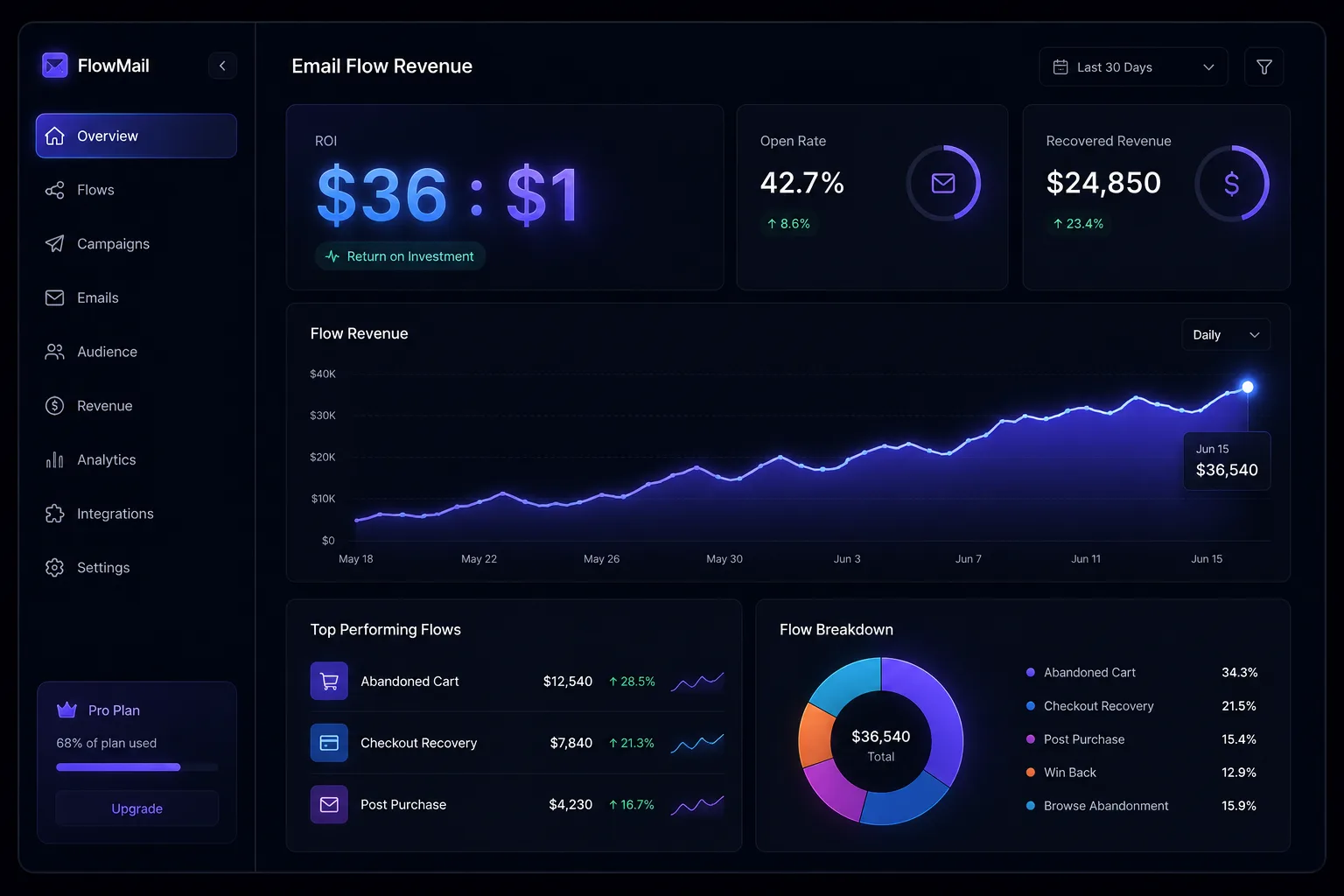
Illustrative example—hypothetical. A store doing ~$40k/month with no automated email turns on these five flows. If flows reach the healthy benchmark of ~58–65% of email revenue and email contributes even a modest share of total sales, that's thousands in recovered revenue per month—from carts and customers they were already paying to acquire. (Benchmarks: Klaviyo and 2026 ecommerce email reports; figures are industry averages, not a guarantee.)
How Virexo Media helps with email automation
Templates get you started; mapping them to your store, products, and margins—then testing them—is what makes them pay. Our team designs and writes high-converting email automation for D2C and Shopify brands as part of our content creation and website development work, so all five flows are live and selling around the clock. For the bigger retention picture, see our email + SMS retention guide and Klaviyo for Shopify guide.
The numbers behind the work: 80+ clients served, 50+ Shopify stores built, 200+ campaigns managed, and a 5.2x average ROAS across our ecommerce work.
"The Shopify store they built for us is stunning and converts like crazy. Combined with their performance marketing, our revenue tripled in the first quarter."
— Ayesha Khan, E-Commerce Manager, LuxeWear (UAE)
Frequently asked questions
What are the 5 essential ecommerce email flows?
Welcome, abandoned cart, browse abandonment, post-purchase, and win-back. Together they cover the whole lifecycle—greeting new subscribers, recovering lost sales, and turning one-time buyers into repeat customers—and they run automatically once set up.
Which email flow makes the most money?
The abandoned-cart flow is the single highest-leverage automation, because the shopper already chose the product. A 3-email sequence recovers far more than a single reminder, and sending the first email within ~60 minutes recovers meaningfully more carts.
How many emails should an abandoned-cart flow have?
Three: a reminder within ~60 minutes, an objection-handler around 24 hours, and a light incentive around 48 hours. A 3-email sequence recovers roughly 6.5x more revenue than sending just one.
Should email flows lead with a discount?
No—leading every email with a discount trains buyers to wait for one and erodes your margin. Lead with the reminder, the product, and proof; save any incentive for later in the sequence, and prefer free shipping over a discount where you can.
How much revenue should automated flows drive?
A healthy benchmark is roughly 58–65% of your email revenue coming from automated flows (Klaviyo / 2026 reports). The exact figure depends on your store, but the point is clear: flows, not one-off campaigns, are where automated email revenue compounds.
Ready to turn on your always-on email engine?
Virexo Media designs and writes high-converting email automation for D2C and Shopify brands—mapped to your store, products, and margins. Book a free strategy call and we'll set up all five flows so your store keeps selling around the clock.
Explore our content creation, website development, and performance marketing pages.
Want a free audit of your store?
Book a 15-minute call with Virexo Media. We'll review your Shopify site, ads, or SEO — and send a prioritized action list within 48 hours. No pitch deck. Just clarity.