7 Ecommerce Mistakes Quietly Killing Your Sales
Getting visits but not sales? The 7 ecommerce mistakes quietly killing your conversions—speed, product pages, checkout, trust, email, mobile—and how to fix each this week.
Most stores don't have a traffic problem—they have a leak problem. If you're getting visits but not enough sales, the issue is usually a handful of fixable ecommerce mistakes that quietly drain conversions before checkout. The good news: the seven below are things you can act on this week, mostly without spending another dollar on ads. Work through them top to bottom—it's the same leak hunt we run on Shopify and D2C store builds. For a scored version, pair this with our 7-point store audit.
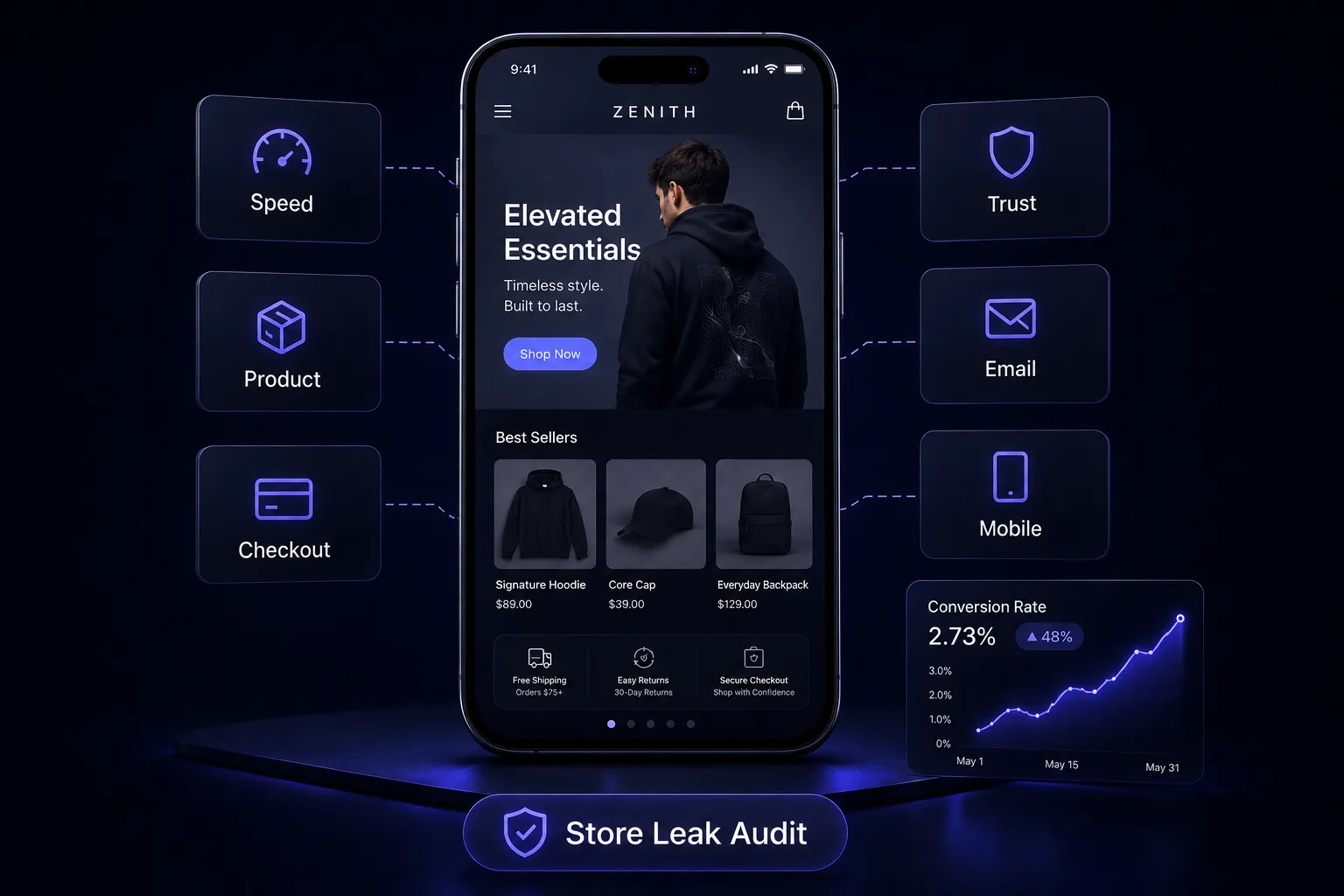
Prefer the printable version? Download the free Store Leak Audit (PDF)—the 7 fixes and quick wins on one page.
What's inside this audit
- The 7 mistakes that quietly kill ecommerce sales—each with the fix
- A 15-minute quick win for every one
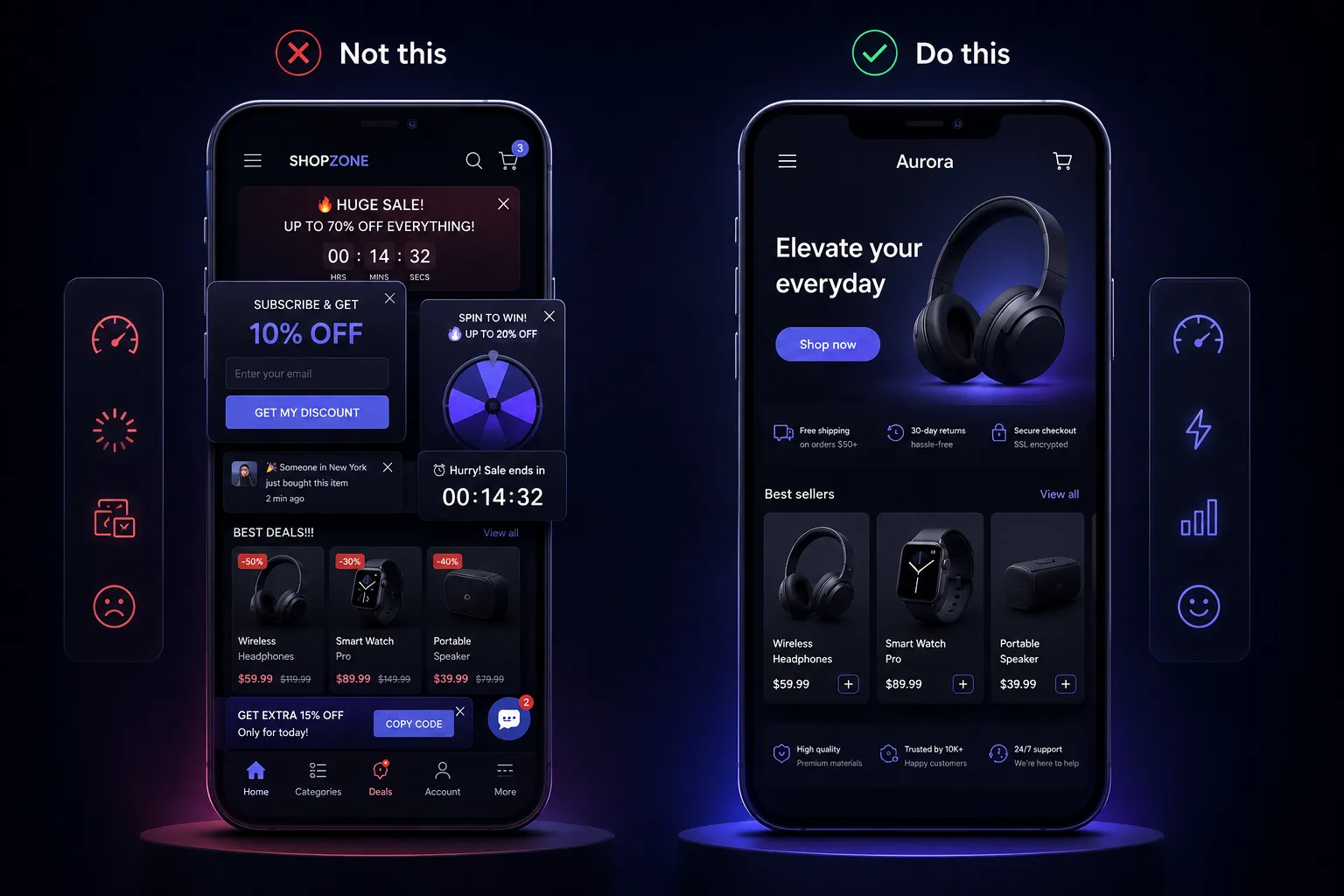
- The "not this / do this" version so you know exactly what to change
- The common pitfalls to avoid before you start
- A simple "what good looks like" benchmark for the math
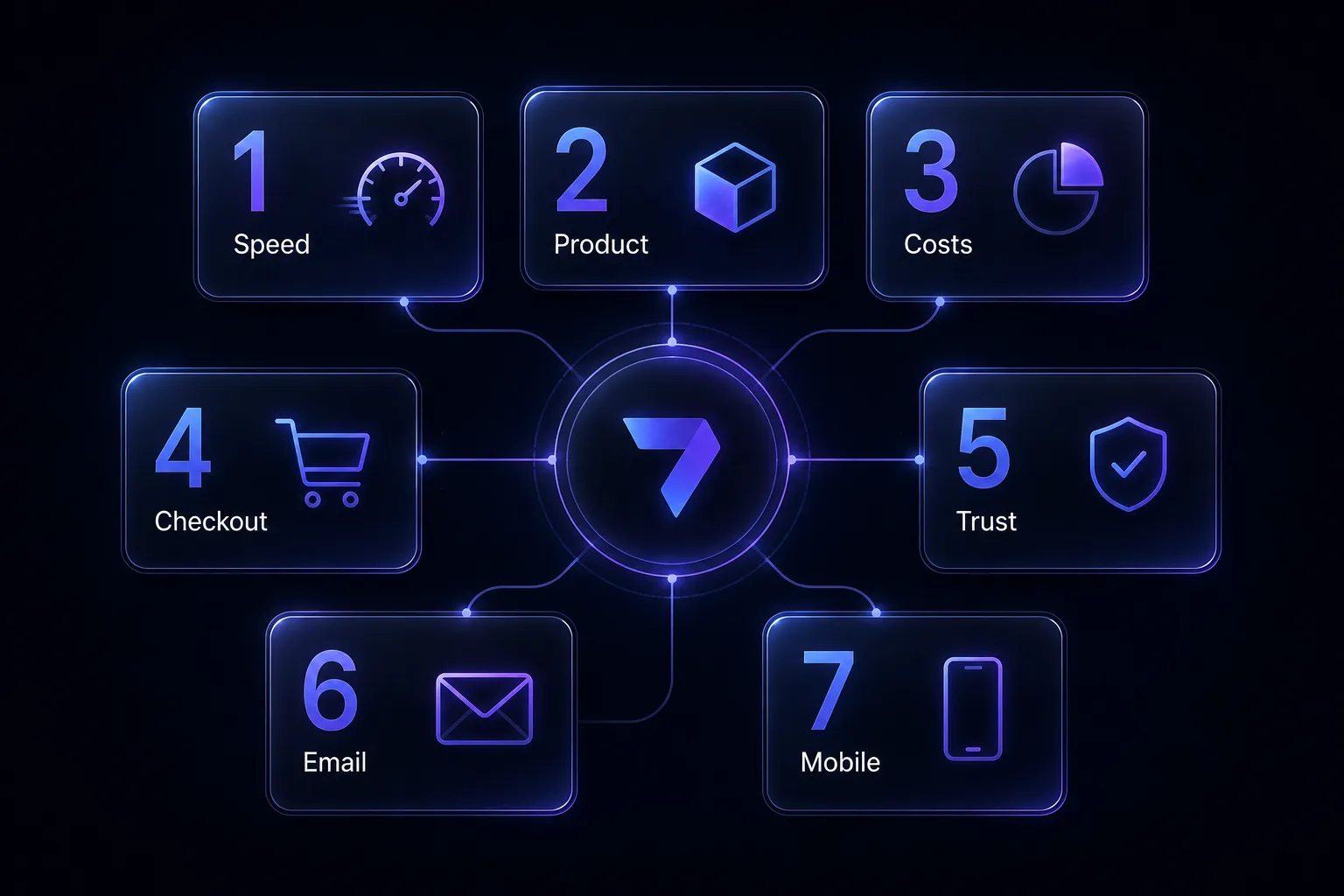
1. Your store is too slow—especially on mobile
Why it costs you: shoppers bail on pages that take more than ~3 seconds to load, and Google/Deloitte retail research found that even a 0.1s speed improvement measurably lifts conversion. Speed is the first impression you never see. Not this: ten apps, giant uncompressed hero images, autoplay video, a heavy theme you never trimmed. Do this: compress images (WebP), remove unused apps, lazy-load below the fold, and pick a lightweight theme.
Quick win (15 min): run your homepage and top product page through Google PageSpeed Insights, then compress the 3 biggest images it flags.
2. Weak product pages that don't answer the buyer
Why it costs you: the product page is where the buying decision is actually made. Thin descriptions, two photos, and zero answers to obvious questions force the shopper to guess—and guessing shoppers leave. Not this: one stock photo, a spec dump, no sizing/shipping/returns info, no social proof. Do this: 5+ real photos, benefit-led copy, answers to the top 3 buyer questions on the page, and reviews near the buy button. (Full detail in our product page checklist.)
Quick win: pick your best-selling product and add the 3 questions customers email you most—answered right on the page.
3. Surprise costs that only show up at checkout
Why it costs you: per the Baymard Institute, unexpected extra costs (shipping, fees, tax revealed late) are the single most common reason people abandon carts—cited by roughly half of abandoners. Not this: hiding shipping until the final step, then watching carts evaporate. Do this: show shipping early, set a free-shipping threshold, and add a progress bar ("You're $12 away from free shipping").
Quick win: add a shipping estimate to the cart drawer and a free-shipping bar to the header.
4. A clunky, too-long checkout
Why it costs you: Baymard puts the average documented cart-abandonment rate around 70%, and a complicated or too-long checkout is one of the biggest drivers. Every extra field is a chance to lose the sale. Not this: forced account creation, 15 form fields, no express payment options. Do this: enable guest checkout, cut fields to the essentials, and turn on Shop Pay / Apple Pay / Google Pay. (See the full cart-recovery playbook.)
Quick win: switch on accelerated checkout buttons in your theme settings today—it's a toggle.
5. No trust signals
Why it costs you: a first-time visitor doesn't know you. With no reviews, no guarantee, no clear return policy, and no real contact details, the safe choice for them is to not buy. Not this: zero reviews, no policies, a generic "info@" and nothing that says a real human is behind the store. Do this: reviews on product pages, a money-back guarantee, a visible return/shipping policy, and a secure-checkout cue.
Quick win: install a review app and add a one-line guarantee badge under your add-to-cart button.
6. You capture no emails and never follow up
Why it costs you: most first-time visitors won't buy on visit one. With no email/SMS capture and no automated follow-up, you pay to get them once and then lose them forever. Not this: no popup, no welcome email, no abandoned-cart reminder—traffic in, traffic gone. Do this: offer real value for an email, then run a welcome flow plus an abandoned-cart flow on autopilot. (Grab the templates in our email automation swipe file.)
Quick win: turn on a single abandoned-cart email—it's the highest-ROI automation you can ship in an hour.
7. Mobile treated as an afterthought
Why it costs you: the majority of ecommerce traffic is on phones. If your store was designed on a desktop and never properly tested on mobile, you're leaking your biggest audience by default. Not this: tiny tap targets, text you have to pinch-zoom, a buy button that scrolls off-screen. Do this: thumb-friendly buttons, readable type, a sticky add-to-cart, and a checkout tested end-to-end on a phone.
Quick win: buy something from your own store on your phone right now. Whatever annoys you, fix that first.
Common pitfalls (read before you start)
- Chasing more traffic to fix a conversion problem—you'll just pay to pour water into a leaky bucket.
- Changing ten things at once, so you never learn which fix moved the needle. Change, measure, then change again.
- Copying a big competitor's look without their data, budget, or brand trust behind it.
- Ignoring on-site search and filtering—high-intent shoppers who can't find it, don't buy it.
- No analytics events on add-to-cart and checkout steps, so you're guessing where the leak even is.
What good looks like
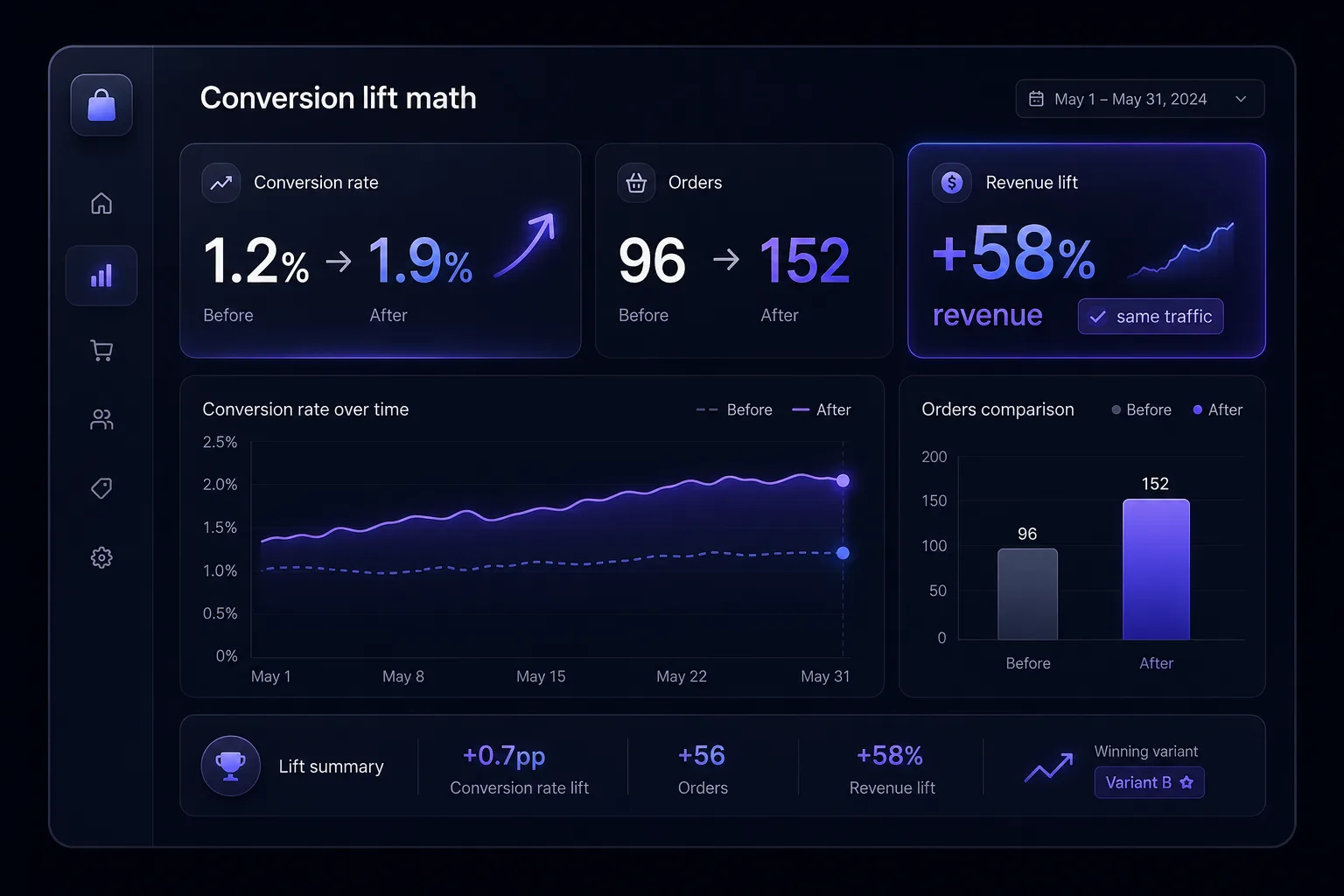
Example, illustrative. A store gets 8,000 visits a month and converts at 1.2%—about 96 orders. Plug the checkout and product-page leaks and lift conversion to 1.9%, and the same traffic becomes ~152 orders. That's ~58% more revenue with zero extra ad spend. (Figures are illustrative, to show the math—not a guaranteed or actual client result.)
How Virexo Media helps plug the leaks
We build and optimize high-converting Shopify and D2C stores—from speed and product pages to checkout, trust, and the automations that recover lost sales. We find the leaks, then fix them. If you'd rather have it done for you, that's the work: store design and CRO, paired with the email flows and funnel that compound it.
The numbers behind the work: 50+ Shopify stores built, 6x average organic traffic growth in 6 months, and $2.4M+ in revenue generated for clients.
"The Shopify store they built for us is stunning and converts like crazy. Combined with their performance marketing, our revenue tripled in the first quarter."
— Ayesha Khan, E-Commerce Manager, LuxeWear (UAE)
Frequently asked questions
Why is my ecommerce store getting traffic but no sales?
It's almost always a conversion problem, not a traffic one. The usual leaks are a slow store (especially on mobile), weak product pages, surprise costs at checkout, a clunky checkout, missing trust signals, no email follow-up, and a mobile experience that was never properly tested. Fix those and the traffic you already have converts better.
What are the most common ecommerce mistakes that kill sales?
The seven in this guide: slow load speed, thin product pages, surprise shipping/fees at checkout, a too-long checkout, no trust signals, no email capture or follow-up, and treating mobile as an afterthought. Each one quietly drops conversions before the sale.
Why do shoppers abandon their carts?
Per the Baymard Institute, unexpected extra costs revealed late (shipping, fees, tax) are the single most common reason—cited by roughly half of abandoners—and the overall documented cart-abandonment rate averages around 70%. A long or forced-account checkout is another big driver.
How fast should my ecommerce store load?
Aim to load in under ~3 seconds, especially on mobile—shoppers bail past that, and research shows even a 0.1-second improvement measurably lifts conversion. Compress images to WebP, trim apps, and choose a lightweight theme.
How do I fix low conversion without buying more traffic?
Plug the seven leaks above, starting with the highest-impact, lowest-effort ones: turn on accelerated checkout and an abandoned-cart email, show shipping early, and add reviews near the buy button. Change one thing at a time so you can see what actually moved conversion.
Ready to find your store's biggest leak?
Virexo Media builds and optimizes high-converting Shopify and D2C stores—we find the leaks, then fix them. Book a free strategy call and we'll audit your store's biggest leak for free and send a prioritized action list within 48 hours.
Explore our website development, SEO services, and performance marketing pages.
Want a free audit of your store?
Book a 15-minute call with Virexo Media. We'll review your Shopify site, ads, or SEO — and send a prioritized action list within 48 hours. No pitch deck. Just clarity.